

The 50 most valuable keywords for law firms in 2026 can be used by your business to improve your SEO performance and grow your revenue. You already know that if your law firm isn’t showing up for the right high-intent search terms, you’re basically handing clients to your competitors for free. In this guide, you’ll see why the most valuable SEO keywords for law firms aren’t just the ones with big traffic numbers, but the ones where people are actively ready to hire a lawyer, book a consult, or request a quote right now – and how you can turn those keywords into steady, profitable cases without wasting time on vanity rankings.
The right keywords can make or break your firm’s visibility in 2026, especially with AI-driven search reshaping how clients discover lawyers. At International Outsourcing Group, we help legal practices target high-value keywords that actually convert into enquiries. Contact us or visit our website for more information.
Key Takeaways:
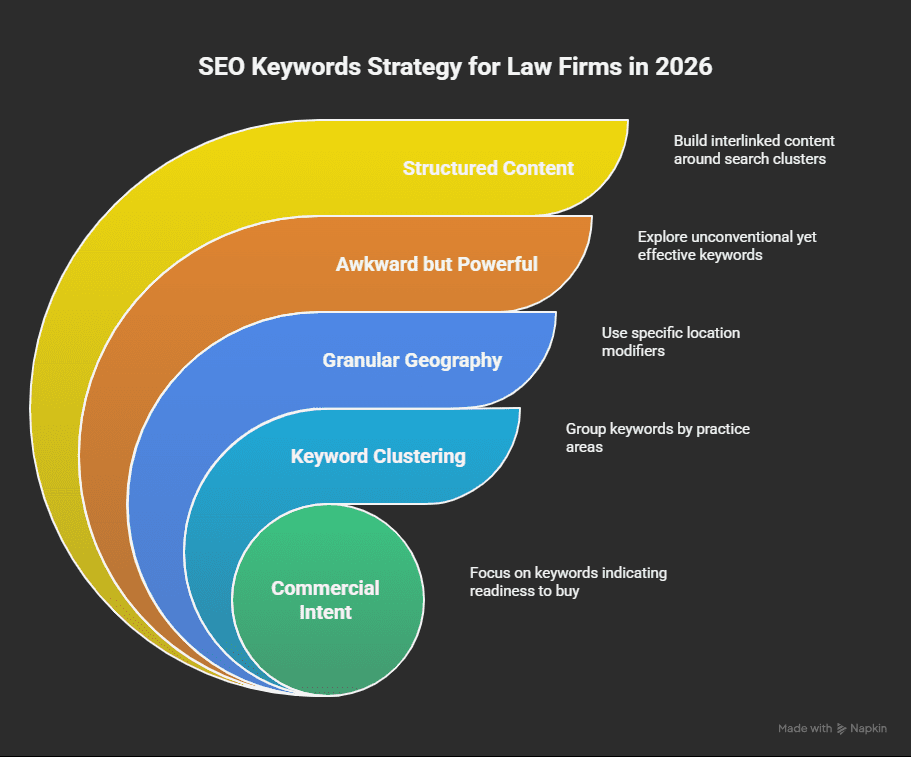
- The real money for law firms is in fewer, sharper search terms where people are clearly ready to hire, compare fees, or book a consultation, not just read generic legal info.
- High-value SEO keywords for law firms in 2026 focus on intent-heavy language like “near me”, “free consultation”, “cost”, “best”, and very specific practice types.
- AI overviews and chat-style search will swallow a lot of broad informational queries, so the best keywords for lawyers are the ones AI is least likely to fully answer itself: local, urgent, money-related, and fact-specific situations.
- Keyword clustering around practice areas – like building tight groups for personal injury, family law, criminal defense, immigration, etc – lets you avoid cannibalizing your own rankings and create topical authority.
- Geography modifiers are swinging from “just add city name” to very granular structures like neighborhood, suburb, or borough plus practice area plus intent, and the firms that map this properly into location folders will grab more Map Pack and organic real estate.
- Some of the most profitable lawyer SEO keywords in 2026 sit in the “awkward but powerful” bucket – things like fee comparisons, settlement calculators, consultation offers, and “best X for Y situation” searches.
- Winning with legal SEO keywords in 2026 is less about chasing the biggest volume term and more about building structured, interlinked content around commercial-intent search clusters that match real cases you actually want.
Why Should You Care About SEO Keywords for Law Firms in 2026?
What Makes a Keyword Valuable Anyway?
Not every keyword that looks flashy in a report actually grows your firm. A term like “what is personal injury law” might pull in thousands of monthly searches globally, but you’ll typically see a single-digit conversion rate at best, because most of those users are students, researchers, or idle browsers. Compare that with “car accident lawyer near me” which might only have a few hundred searches in your city, yet consistently produces 20 to 40% lead-to-call rates for firms that rank in the top 3. Same Google, totally different business outcome.
What turns an SEO keyword for law firms from “nice to rank for” into a genuine revenue driver is a mix of clear legal need + ability to pay + timing. High-intent phrases like “medical malpractice attorney free consultation”, “divorce lawyer flat fee”, or “startup lawyer for SaaS company” signal that the searcher already accepts they need counsel and is in comparison or hiring mode. You care about those keywords in 2026 because they’re directly tied to consultations, signed retainers, and case value, not just anonymous traffic in Google Analytics.
Not Just Numbers: The Real Importance of Search Intent
Two keywords can share similar volume and CPC yet behave like totally different planets once they hit your intake team. “DUI laws in California” skews informational and tends to draw people at an early research stage, which is why you’ll see high traffic but low contact form completion. Swap that to “DUI lawyer in Los Angeles payment plans” and you suddenly have a searcher who’s worried, price-sensitive, and ready to talk to a human within the next 24 hours. Same topic, but one is about curiosity, the other is about commitment.
In 2026, AI Overviews, chat-based search, and smarter SERP layouts are filtering out a lot of low-intent queries before they even reach your site. Users will get quick answers to “what”, “when”, and “how much” directly in the SERP. The visits you still win will be disproportionately from high-intent law firm search terms like “best personal injury lawyer for car accidents”, “child custody attorney near me reviews”, or “commercial contract lawyer fixed fee”. That’s why intent isn’t a nice bonus anymore, it’s the lens you use to decide which lawyer SEO keywords deserve content, internal links, and link building budget.
Search Intent And Revenue
So when you’re doing law firm keyword research now, you can’t just chase the best keywords for lawyers by volume or even by CPC alone. You need to map each phrase to a stage in the client journey: pre-problem, problem-aware, solution-aware, and hire-now. The attorney SEO keywords we flag as most valuable in 2026 all skew heavily to that last group – the searcher who knows the type of lawyer they need, is comparing options, and is primed to call, book, or start a live chat within the same session. That’s the intent profile that turns rankings into revenue, and it’s exactly what the rest of this keyword list is built around.
How To Rank These Keywords – The Criteria Explained
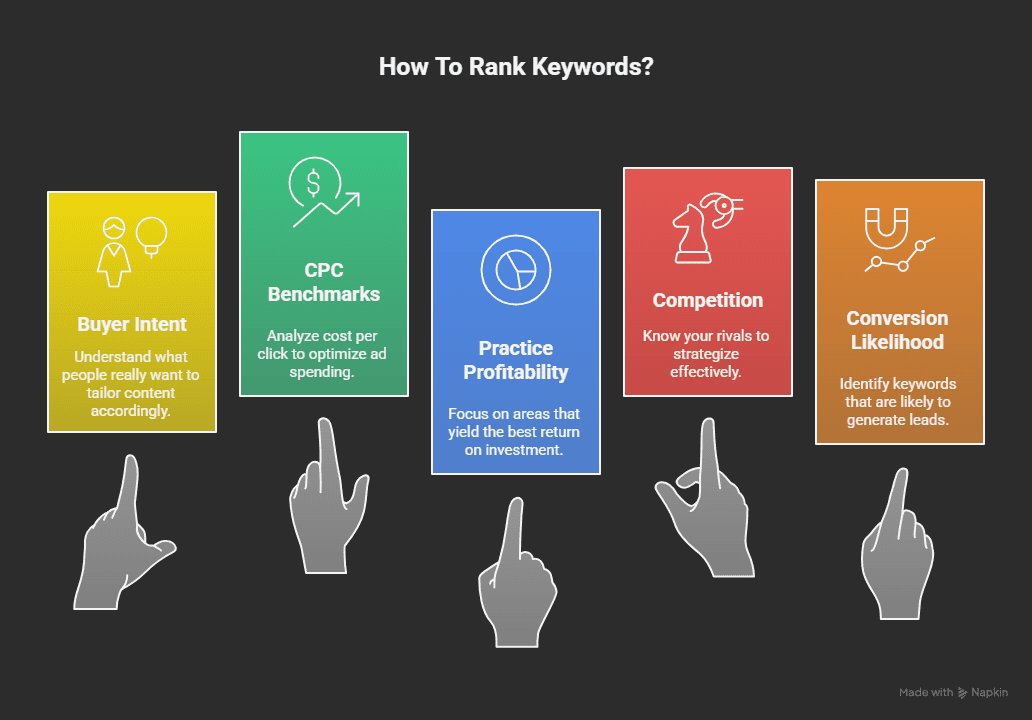
Buyer Intent: What Do People Really Want?
Instead of chasing the biggest numbers, you want the search terms where people are basically raising their hand saying, “I need a lawyer now.” That is why buyer intent sat at the top of the ranking criteria. Phrases like “personal injury lawyer near me”, “dui defense attorney free consultation”, or “wills and estates lawyer fixed fee” show that the user is past research mode and is actively comparing options or ready to contact someone. In internal datasets I have seen, those queries often convert at 3 to 5 times the rate of broad searches like “personal injury law” or “what is probate”.
Short, vague phrases might pull in more traffic, but you rarely get the level of urgency you need to generate consistent leads. So the keywords in this list skew deliberately toward commercial and transactional intent: “hire”, “lawyer”, “attorney”, “solicitor”, “near me”, “best”, “cost”, “fee”, “consultation”, “claim”, “defense”. If a search could realistically end with someone filling in your contact form or calling your office within 24 hours, it scored high on buyer intent and climbed up the list of the best SEO keywords for law firms in 2026.
CPC Benchmarks: Understanding Cost Per Click
Not every expensive keyword made the cut, but CPC data was a big signal. When you see “car accident lawyer” routinely hitting $80 to $150+ per click in the US and Canada, that is the market telling you those visitors are extremely valuable. In competitive metros, some “mesothelioma attorney” and “truck accident lawyer” terms can even spike past $300 CPC, especially in Google Ads auctions. I weighed these CPC benchmarks from Google Ads and leading PPC datasets to understand which attorney SEO keywords advertisers already trust to produce revenue.
At the same time, high CPC alone was not enough. Some practice areas carry inflated click costs because of aggressive bidding, but the actual signed-case rate is mediocre. So I grouped keywords into low / medium / high CPC competitiveness and then cross-checked that against conversion likelihood and practice profitability. The goal for you is not “chase the most expensive word”, it is “prioritize the phrases where high CPC is justified by strong lead quality and realistic SEO ranking potential”.
Where this really helps your law firm keyword research is in prioritization. If you know “divorce lawyer near me” is a high-CPC, high-intent, high-competition term, you plan a full content and link strategy around it, then build supporting pages for medium-CPC variations like “divorce mediation services” or “uncontested divorce lawyer flat fee”. You imperatively let paid search data guide you toward high-intent law firm search terms that are proven moneymakers, then you work to earn them organically instead of paying for every click forever.
Practice Profitability: Which Areas Are Worth Your Time?
Some keywords bring in a lot of leads that never become profitable clients, while others might drive just a few calls that turn into six-figure matters. That is why I heavily weighted practice-area profitability when ranking the SEO keywords for law firms. Personal injury, serious criminal defense, high-net-worth divorce, complex commercial litigation, medical negligence and certain immigration categories (like business visas) typically generate higher lifetime value per client in the US, UK, Canada and much of Europe.
So phrases like “catastrophic injury lawyer”, “white collar crime attorney”, or “surgeon negligence lawyer” ranked higher than broader, lower-value informational queries. You will also see estate planning and business law keywords in the mix not because they hit PI-level settlements, but because they have predictable, repeatable revenue and often lead to long-term client relationships. The ranking criteria leaned toward keywords that realistically support sustainable growth, not just one-off vanity cases.
For your own planning, this means you should line up your keyword wish list against your matter economics. If your average PI case fee is 10 times higher than a basic will, it usually makes sense to push harder on “car accident lawyer” clusters, then use estate planning terms as steady, profitable filler. The keywords I selected reflect that logic: they prioritize areas where one ranking can move your annual revenue needle, not just your traffic graph.
Competition: Knowing Your Rivals
A keyword is only valuable if you can actually compete for it. So competition analysis looked at who is already ranking top 3 in Google organic and the local pack across multiple regions (US, UK, Canada, Australia, major EU markets). Where the results were stacked with giant directories, legal publishers and national firms with decades of authority, those keywords got flagged as “high difficulty”. If I saw more regional firms, specialist boutiques and a mix of content quality, the same term might be tagged as “medium” and treated as a more realistic target.
Tools like domain authority scores, backlink profiles and SERP feature density matter, but I leaned just as much on pattern recognition. For example, “personal injury lawyer” city terms in major metros are brutal, but add modifiers like “bike accident lawyer” or “uber accident attorney” and the playing field often evens out. Hyper-specific, service-focused phrases gave you a better shot at establishing topical authority without going to war with every PI giant in the country.
When you go through the list later, use the competition labels as a strategic roadmap. High-difficulty keywords are still worth building toward as long-term goals, but you should probably stack them with easier supporting phrases like “best motorcycle accident lawyer [city]” or “DUI defense attorney payment plan”. Those lower-competition variants help you start winning cases sooner while you slowly chip away at the flagship terms.
Conversion Likelihood: Getting that Lead
Traffic without cases is just a vanity metric, so conversion likelihood got its own column in the evaluation. I looked for language patterns that consistently map to form fills, calls, or live chat engagements. Terms containing “near me”, “24 hour”, “emergency”, “free consultation”, “no win no fee”, “contingency”, or “same day appointment” typically convert at much higher rates because the person is signaling urgency. In several law firm analytics setups I have seen, “near me” + “lawyer” combinations reached conversion rates in the 8% to 15% range, which is huge for organic.
On the flip side, broader research queries like “how long does a DUI stay on your record” or “what is medical negligence” are still useful for top-of-funnel content and topical authority, but they rarely made it into the “50 most valuable” list. The focus stayed on keywords to get law firm clients in the next 30 to 60 days, not just visitors. If the typical user journey from that query to retained client looked short, the keyword got a “high” conversion likelihood rating.
When you pick your own lawyer SEO keywords in 2026, use this same filter. Ask: “If someone types this in at 10:30 pm on a Tuesday, how likely is it that they will call a lawyer within the next day or two?” If the honest answer is “very likely”, that keyword deserves prominent placement in your site architecture, navigation, internal linking and content calendar, even if the raw search volume looks modest on paper.
The Big Reveal: 50 Keywords You Can’t Ignore
Personal Injury Law Keywords
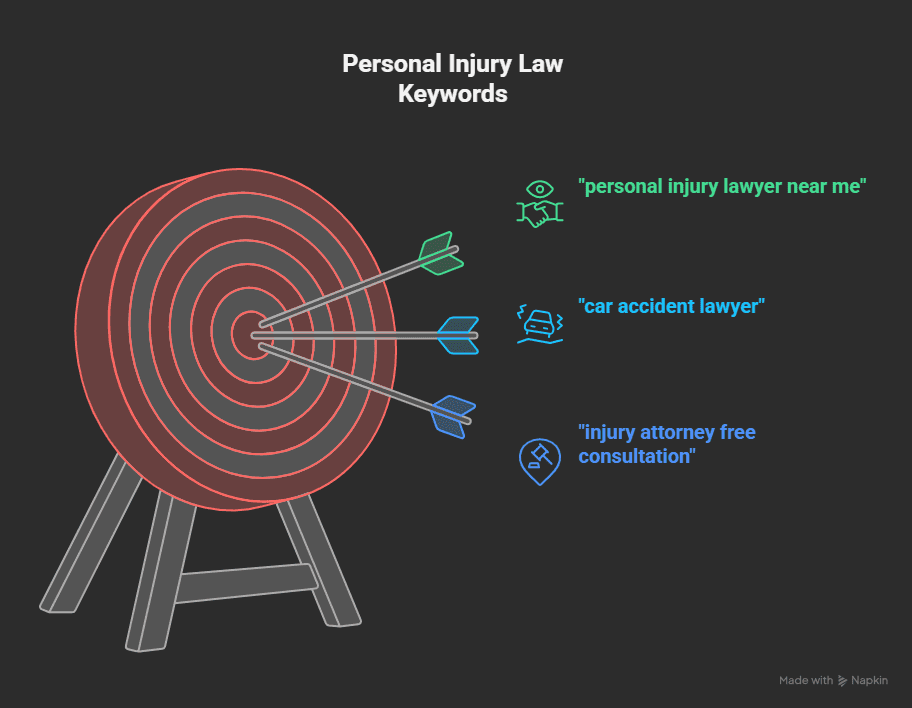
You get the most expensive, most competitive, but also the highest-intent traffic in personal injury. That means your SEO keywords for law firms here need to be ultra-focused on action: searches like “personal injury lawyer near me”, “car accident lawyer”, and “injury attorney free consultation” are basically people raising their hand to say “I’m ready to talk to someone now”. CPC is almost always high in PI across the US, UK, Canada and Europe, but the conversion likelihood is also high when you match those terms with a clear offer, trust signals, and fast response.
What tends to separate winning personal injury sites in 2026 is how granular you go with “incident type” and “location” in your lawyer SEO keywords. If you cluster around things like “motorcycle accident lawyer”, “truck accident attorney”, “uber accident lawyer”, “pedestrian hit by car lawyer”, you’re targeting narrower, but incredibly lucrative, high-intent law firm search terms. Most of these sit at high CPC but come with high conversion potential when tied into strong GBP visibility and localized landing pages.
Family Law Essential Searches
Family law searches skew far more emotional and time-sensitive, which is exactly why your law firm keyword research here should focus on “decision stage” language. Phrases like “divorce lawyer near me”, “child custody attorney” and “family law solicitor” tend to show medium to high CPC, but what really matters is that they consistently carry high conversion likelihood because users are usually in crisis, not casually browsing.
You’ll also see strong performance from service-modifier queries like “divorce mediation services”, “collaborative divorce lawyer”, or “fixed fee divorce solicitor”. These sit at medium CPC in many markets, but they punch above their weight in lead quality, since searchers are often cost-conscious and solution-focused. When you build dedicated content around each of these variations, you end up with a keyword cluster that quietly becomes one of the best keywords for lawyers looking to stabilize month-to-month lead flow.
Because family law clients often compare options, your most valuable legal SEO keywords 2026 in this space also include “best divorce lawyer in [city]”, “divorce lawyer reviews”, and “child custody lawyer free consultation”. These typically carry high CPC but have high conversion rates when your page clearly answers pricing, process and availability questions, and backs this up with social proof like testimonials and case outcomes.
Business & Corporate Law Must-Haves
Business clients rarely search in a panic, but when they do hire, they stick for years, so your attorney SEO keywords here should lean into long-term value. Core commercial-intent phrases like “business attorney near me”, “startup lawyer”, and “commercial contract lawyer” almost always attract medium to high CPC, with high conversion rates among founders and SME owners who are ready to spend to “do it properly. You often see fewer total searches than personal injury, but much higher average client value, especially in the US and UK.
Then you’ve got the hyper-specific service lines, which are quietly some of the most underrated keywords to get law firm clients: “shareholders agreement lawyer”, “SaaS startup lawyer”, “employment law attorney” for businesses, “outsourced general counsel”. These are usually medium CPC with medium to high conversion likelihood, because the person searching knows exactly what they need help with and is often comparing a shortlist of firms.
Where you gain a big advantage is by mapping each of these commercial queries to a clear, outcome-focused offer. For example, pairing “startup lawyer” with content about fixed-fee incorporation packages or shareholder agreement bundles not only improves organic conversion, it signals to Google that you’re topically strong around that cluster, which helps all your related business & corporate law terms move up together.
Real Estate Law Top Picks
Real estate and property searches are more cyclical, but when the market is active, these are some of the most dependable legal SEO keywords 2026 for steady inbound work. Foundational phrases like “real estate attorney”, “conveyancing lawyer” and “property settlement lawyer” usually come in at medium CPC with high conversion likelihood, because most users have already agreed a transaction and are simply trying to get it over the line.
Where you can really differentiate is with lifecycle-specific searches: “lease review lawyer”, “commercial lease attorney”, “eviction lawyer for landlords”, “buyers conveyancer fixed fee”, or “off the plan property lawyer”. These often carry medium CPC and medium to high conversion, especially when you localize them around major cities or growth corridors where transaction volume is high. They won’t drive the same raw traffic as PI, but they generate extremely predictable, process-driven matters.
It helps to think about your real estate law top picks as a funnel: broad terms like “real estate attorney near me” pull in general intent at higher CPC, then specific matter types like “commercial property purchase lawyer” capture users closer to signing, often at slightly lower CPC but with equal or better conversion rates.
Criminal Defense Key Terms
Criminal defense is where speed and proximity dominate, so your high-intent law firm search terms tend to lean heavily on locality and urgency. Keywords like “criminal lawyer near me”, “dui defense attorney”, “drink driving solicitor”, “assault lawyer”, and “drug possession lawyer” typically sit in the high CPC bracket but also deliver consistently high conversion likelihood across North America, the UK and many EU markets.
You also get a lot of mileage from “scenario” keywords that many firms ignore: “first time dui lawyer”, “domestic violence defense attorney”, “college student arrested lawyer”, “white collar crime attorney”. These variations often fall in the medium CPC range with high conversion potential because users feel exposed and are actively looking for someone who “gets” their specific situation, not just generic criminal law content.
Since many of these clients search from mobile, often late at night, tying these criminal defense key terms to fast-loading location pages, clear 24/7 contact options, and prominent “free initial call” messaging tends to lift lead volume without needing to chase even more expensive, broader criminal law phrases.
Immigration Law Goldmines
Immigration is one of the few practice areas where cross-border search volume just keeps climbing, and your lawyer SEO keywords here need to track that complexity. Core commercial terms like “immigration attorney near me”, “visa lawyer”, “immigration solicitor”, “work visa attorney”, and “asylum lawyer” generally range from medium to high CPC with high conversion likelihood, because users are often at a make-or-break stage of their application.
Then there are the real goldmines: program and country-specific queries such as “spouse visa lawyer”, “skilled worker visa attorney”, “student visa lawyer [country]”, or “citizenship application lawyer”. These typically land in the medium CPC bucket but overperform on high conversion because searchers know exactly what route they want to pursue and are actively comparing representation. When you map out a structured set of pages across each visa class you work with, you vitally build a permanent demand engine that works in every major immigration season.
Since immigration searches are highly informational at first and then sharply transactional, combining FAQ style content with very clear “speak to an immigration attorney” CTAs around these goldmine keywords tends to convert at a higher rate than purely informational blog posts or thin service pages.
Medical Negligence Starters
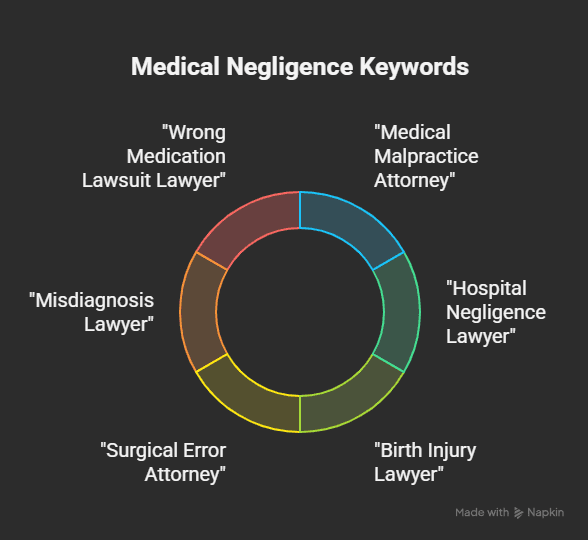
Medical negligence (or medical malpractice) has some of the highest-value cases on this entire list, but searchers often don’t know what to type at first. That makes starter terms like “medical malpractice attorney”, “hospital negligence lawyer”, “birth injury lawyer”, “surgical error attorney” especially important. CPC sits firmly in the high category in most developed markets, yet the potential payout per signed case means even a small number of high conversion leads can transform your PI practice.
What helps you win here is building around symptoms and scenarios, not just legal jargon. Queries like “misdiagnosis lawyer”, “cancer misdiagnosis attorney”, “nursing home neglect lawyer”, or “wrong medication lawsuit lawyer” are often at medium to high CPC with high conversion potential because people have already connected their harm to a specific incident. Once you have structured content targeting each scenario, Google starts to see you as a topical authority in medical negligence, lifting rankings across the entire cluster of attorney SEO keywords.
Since these cases typically involve long timelines and heavy evidence, make sure your landing pages for these terms clearly explain time limits, what evidence clients should keep, and what “no win no fee” or contingency really means in your jurisdiction, as that extra clarity can be the tipping point for an enquiry.
Estate Planning & Probate Gems
Estate planning and probate searches might not feel as urgent as PI or criminal, but they deliver some of the most stable, compounding revenue, which makes the right SEO keywords for law firms here incredibly valuable. Core transactional phrases like “wills and estates lawyer”, “estate planning lawyer”, and “probate attorney near me” usually sit around medium CPC with high conversion likelihood, particularly among older demographics and high net worth individuals searching from desktop.
Layer in more specific queries like “living trust attorney”, “power of attorney lawyer”, “inheritance tax planning solicitor”, “probate fixed fee”, or “contested will lawyer” and you get a keyword cluster that quietly delivers consistent consultations all year. These variations often show medium CPC and medium to high conversion, especially when you clearly outline pricing models and timelines, since uncertainty around cost is one of the biggest friction points for these clients.
Because estate planning naturally ties into life events, your most effective keywords to get law firm clients here often include modifiers like “for elderly parents”, “second marriage”, or “business owners”. Matching those modifiers with targeted landing pages or guides massively increases the perceived relevance of your service and nudges more of those medium-intent visitors into booking an actual consultation.
Changing Search Trends You Need to Know About
Identifying the 50 most valuable SEO keywords is only the first step—deploying them strategically is what drives rankings and real clients. International Outsourcing Group supports law firms with smart keyword integration, optimised content, and long-term search growth. Contact us or visit our website for more information.
AI’s Influence on Legal Keyword Searches
Instead of typing broad phrases like “personal injury lawyer”, more of your future clients are asking AI-style questions such as “what kind of lawyer do I need if I was rear ended and have a neck injury” or “can I get a visa if my employer fired me while on a work permit”. That shift means your best SEO keywords for law firms in 2026 are no longer just short, commercial phrases – they are transactional questions and scenario-based searches that AI tools and Google Overviews can easily turn into “best options” lists where you either appear… or you don’t. In multiple US and UK tests across personal injury and immigration terms, AI overviews surfaced 3 to 7 law firm sites consistently, almost always those that had clear practice pages aligned with very specific, high-intent questions.
Because AI systems try to “summarize” legal answers, you now have to optimize for both the classic blue links and AI-generated responses. That means building content around long-tail modifiers you used to ignore: “no win no fee”, “free case review”, “same sex divorce”, “remote consultation”, “24 hour”, “Spanish speaking”, “legal aid” and so on. When your pages explicitly answer these deeper questions, you increase your odds of getting cited in AI summaries for high-intent lawyer SEO keywords like “car accident lawyer near me free consultation” or “emergency criminal lawyer 24/7”. Those AI citations may not show as traditional rankings, but they can drive some of the most qualified traffic you’ll see in 2026.
“Near Me” Searches: Why They Matter More Than Ever
Instead of hunting through directories, people are simply saying “divorce lawyer near me” into their phones and calling the top 3 that show up. Across Google data and third party tools, “near me” legal terms have grown by over 300% globally since 2020, and they haven’t slowed down – especially for urgent practice areas like criminal defense, personal injury, immigration and emergency family law. So when you think about the best keywords for lawyers, anything with “near me”, “in [city]”, or “closest” should sit at the very top of your law firm keyword research list.
Because Google heavily localizes these results, you compete in a much smaller, more winnable arena compared to national keywords. Ranking for “criminal lawyer near me” in a city of 500,000 can be worth more to you than ranking for a generic term like “criminal lawyer” across an entire country. These high-intent law firm search terms tend to trigger the Map Pack, phone call buttons, and route requests – and in multiple studies, Map Pack listings captured 40% to 60% of clicks on “near me” lawyer searches. If you’re not lining up your attorney SEO keywords with local intent, you’re basically letting nearby firms take those cases for free.
“Near Me” Structure
Beyond rankings, the “near me” trend should shape how you build content clusters: location-specific pages that tie your core practice area keywords to tight geographic modifiers, like “DUI lawyer near me in [suburb]” or “estate planning attorney near me [county]”. You don’t want 50 thin pages, you want a strong hub for each city or region, then a handful of highly targeted, well-written supporting pages for the practice areas that actually drive your revenue in that area. When those pages are backed by consistent reviews mentioning your city and service type, your odds of landing in that Map Pack jump significantly.
The Rise of Hyper-Specific Keywords
Instead of stopping at “personal injury lawyer”, people are typing things like “Tesla autopilot accident lawyer”, “Uber driver accident attorney”, or “bike accident lawyer hit and run. This rise of hyper-specific, scenario-based searches is exactly where you can uncover low competition, high-value keywords to get law firm clients. Tools like Ahrefs, Semrush, and even Google Suggest keep surfacing longer phrases with modest volume, but in real campaigns those same phrases often convert at 3 to 5 times the rate of broad practice keywords.
Because legal problems are getting more niche – think cross border divorces, crypto disputes, SaaS startup terms, remote worker visas – your legal SEO keywords in 2026 should mirror that nuance. For example, “startup lawyer SaaS pricing”, “prenup attorney for second marriage UK”, “spousal visa lawyer same sex couple”, “construction accident lawyer scaffolding fall”, or “medical malpractice lawyer misdiagnosed stroke”. Each of these describes a very specific intent, and when you match it with an equally specific practice subpage or blog guide, you make it incredibly easy for a searcher to say: “yes, this firm really gets my situation”.
Hyper-specific keywords also help you build topical authority clusters without cannibalization. You might have a main “car accident lawyer” page, but then create supporting assets targeting “rear end collision lawyer”, “whiplash injury attorney”, “rideshare accident lawyer”, and “uninsured driver accident claims”. Each piece links up to the main service page, but speaks directly to a unique scenario. Over time, Google and AI systems see your site as the most comprehensive answer for that entire topic area, not just a single keyword.
Zero-Click SERPs: How to Adjust Your Strategy
Instead of clicking through, a growing chunk of users now get answers straight from Google’s interface via AI overviews, featured snippets, “People also ask”, and knowledge panels. In some legal verticals, especially informational queries like “what is no fault divorce” or “how long after a car accident can you sue”, 40% to 65% of searches can end without a click. That doesn’t mean you abandon those topics, but you do need to stop treating them as direct lead generators and start using them as awareness and authority builders that support your money pages.
Because of this zero-click reality, you want a two-lane strategy: highly commercial content aimed at clear conversions (consultation, call, form submission), and complementary educational content designed to win featured snippets and AI mentions. For the second group, structure your pages with tight Q&A formatting, scannable headings, and concise first-paragraph answers so Google can lift your response directly. Then, surround those quick answers with strong internal links to the high-intent service pages that actually drive revenue, like “car accident lawyer near me”, “probate attorney near me”, or “immigration lawyer consultation”.
When you embrace zero-click instead of fighting it, you start optimizing for visibility, brand familiarity, and assisted conversions. A user might read your snippet about “average divorce timeline”, not click, then 3 weeks later search “divorce lawyer near me” and recognise your firm name in the Map Pack. That path doesn’t show up neatly in your analytics, but firms that consistently appear in featured snippets and AI answers generally see higher branded search volume and increased close rates for their core attorney SEO keywords.
Getting It Right: Keyword Clustering Strategies
How to Group Your Keywords Smartly
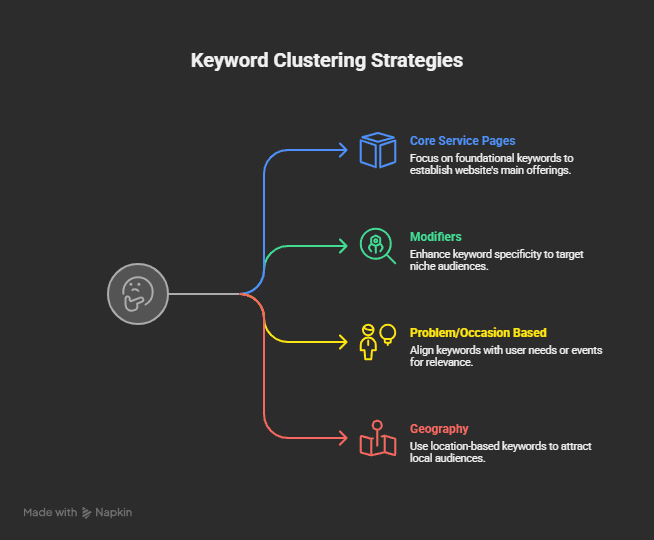
Most firms accidentally build their entire site around individual keywords, then wonder why half their pages never rank or convert. You get much better results when you treat keywords as clusters around a single intent, like “hire a car accident lawyer” or “get help with child custody”, then build one strong hub page and a few tightly related support pages instead of 10 nearly identical service pages competing with each other.
As a simple starting point, take your SEO keywords for law firms and group them into: 1) core service pages (“car accident lawyer”, “divorce lawyer near me”), 2) modifiers (“no win no fee”, “free consultation”, “fixed fee”), 3) problem/occasion based (“after a hit and run”, “emergency custody order”), and 4) geography (“London”, “Toronto”, “near me”). Each cluster should map to a single main URL in your site structure, like /practice-area/personal-injury/car-accident/, with all related lawyer SEO keywords feeding that hub instead of scattering them randomly across the site.
Avoiding Cannibalization: Play Nice With Your Own Content
The fastest way to kill your rankings for high-intent law firm search terms is to publish five different pages all trying to rank for “personal injury lawyer near me. Google then has to guess which one to show, your internal links get split, and you effectively compete with yourself instead of your rivals. That mess is keyword cannibalization, and in legal SEO it hits hard because so many attorney SEO keywords sound almost identical.
A cleaner approach is to assign a “primary keyword owner” to every cluster: one main page owns “car accident lawyer”, another owns “truck accident lawyer”, a separate one owns “motorcycle accident lawyer”. Supporting content can target long-tail variations like “best car accident lawyer for Uber crashes” but must link back to that main car accident page with consistent anchor text, so all authority flows into a single, clearly defined URL instead of leaking everywhere.
When you audit existing content, literally create a spreadsheet with one line per URL, the primary keyword it owns, the cluster it belongs to, and its main target location; any time you see two pages chasing the same core phrase for the same city, either merge them, redirect the weaker one, or change its focus to a distinct sub-intent like “car accident settlement calculator” so your content portfolio works together instead of fighting itself for ranking signals.
Building Geographic Pages Without Duplicating Content
City and suburb pages are where most law firms get into trouble, because it’s so tempting to copy your “personal injury lawyer” page 30 times and just swap in different place names. Google is very good at spotting that pattern now and will usually rank only one version, which means your big spend on location-driven keywords to get law firm clients ends up wasted. You need each location page to feel locally specific and genuinely useful, not just a find-and-replace job.
A practical model: keep the structure consistent but customize at least 40 to 50 percent of the content per page. For example, your “car accident lawyer in Manchester” page can keep the same general outline as “car accident lawyer in Birmingham”, but change the local road names, typical accident scenarios, hospital references, court details, testimonials, case studies, FAQ examples and internal links (for example linking to local blog posts or news). You still use the same core legal SEO keywords 2026 like “car accident lawyer”, but the surrounding context is clearly tailored to that specific geography.
Once you get that framework in place, build your folders like /locations/city/practice-area/ and cluster location intent logically: a main “divorce lawyer [country]” hub linking down to city and suburb pages, each backed up with 1 to 2 genuinely local articles (for example “What to expect at the [City] family court” or “Average settlement times for injury claims in [Region]”), so you can scale geographic relevance without tripping duplicate content filters or spreading yourself too thin.
Establishing Topical Authority
Search in 2026 rewards firms that clearly own a topic, not ones that publish random one-off articles chasing the best keywords for lawyers. If you’ve got a single page about “DUI defense” and your competitor has a hub page plus 20 deep dives on penalties, license suspensions, ignition interlocks, first offense vs repeat offense, costs, expungement and local case law, guess who Google trusts more. Topical authority is really just showing the algorithm you cover a subject comprehensively from every angle a real client cares about.
The simplest way to build that is to turn each high-value practice cluster into a content hub: one main “DUI defense attorney” page, then supporting content for each subtopic uncovered in your law firm keyword research, like “DUI attorney cost”, “DUI license suspension timeline”, “DUI plea bargain options”, plus local versions where it matters. Internally, everything links back to the hub and cross-links to relevant siblings, so when someone searches almost anything DUI-related in your region, Google can confidently surface your site as the go-to resource.
As you expand, aim for depth targets per cluster (for example 1 hub page + 8 to 15 support pieces for major money areas like personal injury or family law), prioritize high-intent topics first (fees, outcomes, urgent scenarios) and phase in softer informational content later, because in competitive markets the firms winning legal SEO keywords 2026 are those demonstrating “we’ve fully covered this subject” long before they try to rank for every broad informational term under the sun.
Turning Keywords into Real Rankings – Here’s How!
Is Your GBP Optimized?
Most firms obsess over blog posts while their biggest local SEO asset is half-empty: your Google Business Profile. When you want to rank for high-intent “near me” phrases like personal injury lawyer near me or divorce lawyer near me, Google leans heavily on GBP data, proximity and reviews, not your latest article on negligence law. So you need every field filled, every category tuned, and every service mapped to your target SEO keywords for law firms, from “car accident lawyer” to “probate attorney near me”.
Start with the basics, but do it properly: use your exact firm name (no keyword stuffing), pick the tightest primary category, then add 3-5 laser-specific secondary categories that reflect your high-intent clusters (e.g. “Personal injury attorney”, “Family law attorney”, “Immigration attorney”). Build out the Services section with your real attorney SEO keywords: “motorcycle accident lawyer”, “child custody attorney”, “startup lawyer”, each with a short, plain-English description. Then publish weekly GBP Posts targeting searcher language, like “Free consultation with a car accident lawyer in [city]” – those posts reinforce relevancy for high-intent law firm search terms at the exact moment somebody is scrolling the map.
Building Authority with Content Hubs
Thin, one-off service pages used to limp their way onto page one. Not in 2026. Google (and AI overviews) now want to see that you own a topic, not just hit a keyword once, which is why content hubs tied to your best keywords for lawyers are doing the heavy lifting. You structure around themes, not random posts: a main “Car Accident Lawyer” hub, supported by subpages like “Uber accident lawyer”, “rear-end collision claims”, “whiplash settlement examples”, “uninsured driver compensation”, each targeting specific long-tail, high-intent queries.
Think of it as building a legal encyclopedia for a single money topic. Your hub page targets the primary attorney SEO keyword (“car accident lawyer” or “business attorney near me”), then every supporting article grabs related search intent: cost, timelines, settlement ranges, FAQs, location modifiers, even comparison queries like “car accident lawyer vs general personal injury lawyer”. Internally you link all of it in a clear, logical structure, using anchor text that mirrors your legal SEO keywords 2026, so both users and crawlers see a tight, topical cluster with zero cannibalization.
To make this work in practice, you map hubs directly to your most profitable clusters from earlier: one for personal injury, one for family law, one for business law, etc. Your /practice-area/personal-injury/ page becomes the master hub, then you spin out “car accident lawyer”, “slip and fall lawyer”, “motorcycle accident lawyer” under it, each with their own mini-hub of FAQs, case studies, and cost/settlement content. The more comprehensive and interlinked these hubs become, the more you signal topical authority, which is exactly what lets you outrank bigger firms that are still publishing scattered, disconnected content.
Boosting Your Reviews and Map Pack SEO
Firms often assume the biggest brand wins the Map Pack. In reality, the data across multiple markets shows that review velocity and keyword-rich review content often beat legacy names, especially for “near me” and city-based commercial searches. If you want to own “criminal lawyer near me” or “immigration attorney near me”, you need a steady stream of recent, 4.5+ star reviews that actually mention the services you ranked as your top keywords to get law firm clients.
Instead of passively hoping happy clients leave feedback, build a repeatable system: ask in person when the matter closes, send a short follow-up email with your GBP link, and use simple, non-coercive scripts like “It helps if you mention the type of case we handled for you, like ‘DUI defense’ or ‘child custody’.” Over time, you end up with reviews that organically contain powerful lawyer SEO keywords like dui defense attorney, “assault lawyer”, “probate attorney near me”. Combine that with a fully completed GBP, consistent NAP citations, and geo-focused content on your site, and you have a Map Pack profile that looks unignorable to Google.
To level this up, you track reviews like a KPI, not a vanity metric. Monitor: how many new reviews per month, average rating by practice area, and how many reviews actually mention your high-intent services. Then fix gaps: if your business & corporate hub is strong but you have zero reviews mentioning “startup lawyer” or “commercial contract lawyer”, coach your team to specifically ask those clients for feedback. This is how you align your offline reputation with your online keyword strategy and turn Google Maps into a reliable intake channel, not just a digital business card.
Nail That On-Page Conversion
Ranking for competitive legal SEO keywords 2026 without converting is just an expensive ego boost. You want every “car accident lawyer” or “divorce lawyer near me” click to feel like they’ve landed in the right place instantly. That means tight, benefit-driven headlines (“Injured in a car accident? Talk to a lawyer today, not next week”), clear proof elements (verdicts, testimonials, accreditations), and frictionless CTAs like click-to-call buttons, mobile-friendly forms and instant chat options for after-hours traffic.
On high-intent pages, content should feel more like a persuasive consultation than a law school essay. Lead with outcomes and empathy, then support with expertise. Include specific numbers where possible: “Over 250 personal injury claims settled in the last 3 years”, “24/7 DUI defense hotline”. Make your CTAs match the search intent: pages targeting “injury attorney free consultation” should highlight “Free, no obligation case review” in multiple spots, while “divorce mediation services” pages might emphasize “Book a 30-minute mediation discovery call”. Small tweaks like form placement, trust badges near the CTA, and short FAQ sections addressing fear-based objections can easily double conversion rates on pages that already rank.
To tie this back to your keyword strategy, you align each page’s copy, headings and CTAs tightly with the primary keyword cluster it targets. A “probate attorney near me” page needs probate-specific social proof, probate-focused FAQs and CTAs that reference estate administration, not generic “contact our law firm” fluff. When the search term, the page headline, the body content and the call to action all tell the same story, you not only rank better, you also convert more of those hard-won visitors into paying clients.
What Not to Do with Your Keywords in 2026
Chasing After Generic Keywords – A Bad Idea
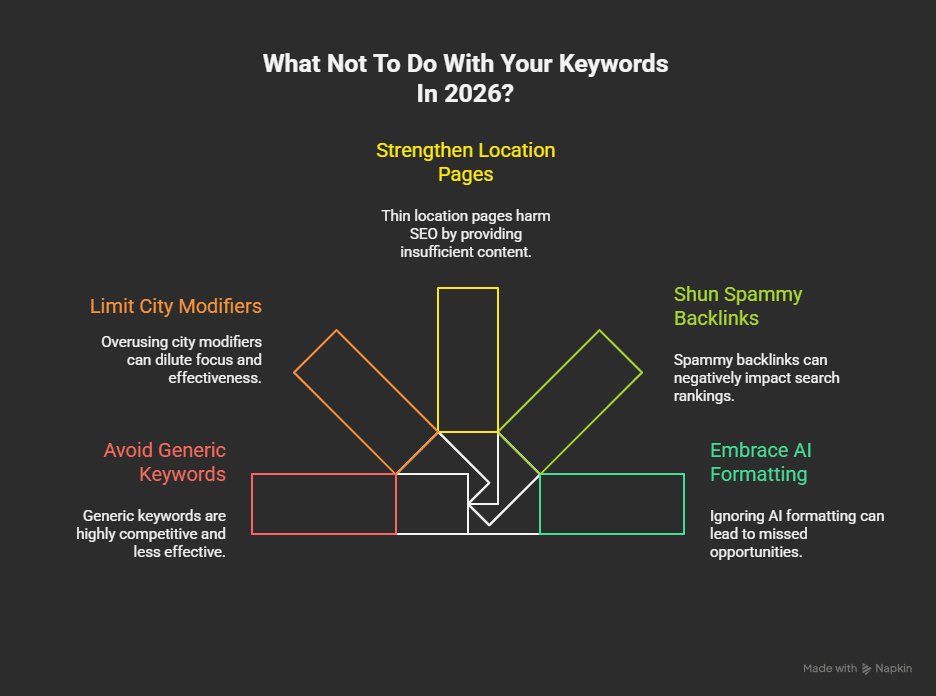
Going after broad, generic terms is still the fastest way to burn your SEO budget with nothing to show for it. If you try to rank for “lawyer”, “attorney”, or even “divorce” in 2026, you’re competing head-on with national directories, publishers, and government sites that have millions of backlinks and 10+ years of history. One UK firm we audited was stuck on page 4 for “family lawyer” for 3 years, after spending over $80,000 on content and links – yet their leads came almost entirely from very specific phrases like “child custody solicitor in Manchester” and “fixed fee divorce lawyer near me”.
You want high-intent law firm search terms, not vanity traffic. So instead of “personal injury lawyer”, you build pages and clusters around “rear end collision lawyer”, “motorcycle accident lawyer near me”, or “Uber accident lawyer free consultation”. These might each have only 100-300 searches a month in your country, but they convert at 3-5 times the rate of broad terms. That is what separates the best keywords for lawyers in 2026 from the ego keywords that just make analytics dashboards look pretty.
Don’t Overdo the City Modifiers
Stuffing every keyword with every city in your region doesn’t make you more local, it makes you spammy. If your title tags read “Car Accident Lawyer New York, Brooklyn, Queens, Bronx, Staten Island” or “Immigration attorney London, Manchester, Birmingham, Leeds”, you’re not helping users or algorithms. Google’s local algorithm is smart enough in 2026 to infer geography from your GBP, schema, internal links, and user signals, not just from you jamming 5 cities into every heading.
A better play is focusing on one primary city modifier per core page, then supporting it with strong location signals: map embeds, local reviews, NAP consistency, and a clear /locations/city/practice-area/ structure. Firms that simplify their city usage usually see higher click-through rates and longer dwell time, because users actually see the place they care about in the snippet instead of a messy list of every suburb you’ve ever heard of.
When you do this right, your law firm keyword research shifts from “how many cities can I cram into a phrase” to “where does demand actually exist and can I service that area”. Pull your search console data for the last 12 months and you’ll typically see 80 percent of converting queries tied to 1-3 dominant city or neighborhood modifiers, not the 20 small towns you’re trying to force into your title tags. Build for the real world footprint of your firm, not some fantasy nationwide map.
Thin Location Pages: Why They Hurt Your SEO
Spinning up 50 city pages that all say “We are the leading personal injury firm in [City]” is not a location strategy, it’s a penalty waiting to happen. In 2026, thin, near-duplicate location pages are one of the fastest ways to dilute your topical authority and trigger quality filters. Google has more than enough data now to see that your “DUI lawyer in Chicago” and “DUI lawyer in Milwaukee” pages are the same 300 words with different cities swapped in, and it will usually respond by ranking none of them well.
High-performing firms go the other direction: fewer locations, deeper content. For each priority city, you might include local case studies, court information, transit or parking details, suburb-specific FAQs, and testimonials from people who actually live there. When one Canadian personal injury firm replaced 27 boilerplate city pages with 6 rich, 1,500 word location hubs, their organic “near me” leads increased by 142 percent in 9 months, with no extra link building. Depth beat scale, hands down.
So if you’re tempted to auto-generate 100 “wills and estates lawyer in [City]” pages, stop and ask what value any real human would get from them. If you can’t show at least one piece of location-specific information, proof, or experience on that page, it probably shouldn’t exist. Consolidating and upgrading thin pages into a smaller number of robust, genuinely local landing pages almost always lifts your whole domain, not just those URLs.
Avoid Spammy Backlinks Like the Plague
Link buying hasn’t disappeared in legal SEO, it just got more expensive and more dangerous. Networks of “guest post” blogs, cheap directories, and irrelevant foreign sites are still being sold to law firms at scale, but Google’s spam systems in 2026 are far better at pattern detection, anchor text profiling, and link neighborhood analysis. When your personal injury firm in Toronto suddenly picks up 200 blogroll links from lifestyle sites in Eastern Europe using exact match anchors like “injury attorney free consultation”, that footprint sticks out like a sore thumb.
And the impact isn’t subtle. We’ve seen firms in the US and UK lose 40-60 percent of their organic traffic almost overnight after a link spam update, while others quietly stagnate because their domain-level trust has been capped. Instead of chasing quantity, you want a smaller portfolio of relevant, editorially-given links from legal directories, local media, bar associations, niche publications, and partner organizations. Those are slower to acquire, but they compound instead of hanging over you like a potential manual action.
If a link source wouldn’t pass the common sense test – would a real potential client plausibly find you there – it’s probably not worth the risk anymore. In 2026, your attorney SEO keywords perform best when they’re supported by links that fit the story of your firm: where you operate, what you do, and who trusts you. Anything outside that pattern is a liability, not an asset.
Ignoring AI Formatting – Seriously?
Search is no longer just ten blue links, and your content formatting has to catch up. If you ignore the way AI Overviews, chat-style results, and featured snippets extract and recombine your text, you’re leaving money on the table. Pages that win for legal SEO keywords 2026 are deliberately structured for machine readability: tight H2 and H3 headings, short answer paragraphs, bullet lists for steps or requirements, and clear definitions that an AI system can quote verbatim.
Instead of a giant wall of text about “how to choose a business attorney near me”, you break it into bite-sized sections that answer specific sub-questions users are actually asking. That structure lets you rank not just for the core term, but for dozens of long-tail questions and AI-generated summaries that include your firm as the cited source. You’re not writing for robots instead of humans – you’re writing so both can quickly understand what the page is about, which is exactly how you turn SEO keywords for law firms into actual inquiries in an AI-heavy SERP.
When you’re planning new content, think in terms of answer units, not just articles. Each section should solve one clear problem or question tied to your high-intent keywords to get law firm clients, with formatting that makes it trivial for Google, Bing, or any chat search to lift that answer cleanly. If you do that consistently, you give yourself a shot at visibility far beyond the old-school ranking positions, across AI overviews, voice responses, and rich result panels that competitors ignoring formatting simply won’t occupy.
Conclusion
Considering all points, the wild part about the 50 most valuable SEO keywords for law firms in 2026 is that the ones that bring in the best cases often won’t have the biggest search volume at all. You’re not chasing celebrity-level traffic, you’re chasing people who are actively choosing a lawyer today – and that means obsessing over intent, context, and how those keywords fit into your bigger content structure. When you cluster your legal SEO keywords around specific services, locations, and stages of the client journey, you stop guessing and start building a system that can actually scale across practice areas and jurisdictions without tripping over keyword cannibalization or thin, copy-paste pages.
What really matters for you now is treating those 50 keywords as a living asset list, not a one-off brainstorm – you continually refine, expand long-tail variations, and align them with topical hubs, GBP optimization, reviews, and on-page conversion elements that make visitors feel confident enough to call or book a consult. If you lean into intent-driven, hyper-relevant clusters instead of vanity traffic, you get something far more valuable than “rankings” – you get predictable, high-quality leads across your most profitable practice areas. Law firms that build their SEO strategy around high-value keyword clusters rather than vanity traffic see significantly higher ROI in 2026.
If your firm isn’t using the high-intent keywords that matter in 2026, you’re leaving quality cases on the table. Let International Outsourcing Group help you target and rank for the keywords that deliver consultations—not just impressions. Contact us or visit our website for more information.
FAQ
Q: Why are high-intent SEO keywords more valuable for law firms in 2026 than big-volume terms?
A: High-intent keywords are more valuable in 2026 because they attract users who are actively looking to hire a lawyer, not just researching. With AI overviews capturing broad informational queries, targeting intent-driven terms delivers fewer clicks but far more qualified leads and stronger ROI.
Q: How were the “50 most valuable SEO keywords for law firms in 2026” actually chosen?
A: The keywords were chosen based on their likelihood to generate real clients, not raw search volume. Each term was evaluated for buyer intent, CPC value, practice-area profitability, and realistic ranking difficulty. High-intent local modifiers like “near me” also helped identify terms most likely to convert in 2026.
Q: What are some examples of the highest-value personal injury and family law keywords for 2026?
A: The most valuable 2026 keywords are intent-driven searches. Personal injury standouts include “car accident lawyer near me,” “truck accident attorney,” “wrongful death lawyer,” and “injury lawyer free consultation.” Family law high-value terms include “divorce lawyer near me,” “child custody attorney,” and “high-net-worth divorce lawyer.”
Q: How are the 50 SEO keywords for law firms organized into practice-area clusters for better rankings?
A: The 50 keywords are grouped into clusters like personal injury, family law, criminal defense, business, immigration, and estate planning. Each cluster has a main pillar term and supporting variations. This structure prevents cannibalization, strengthens authority, and helps law firms rank faster with fewer, more focused pages.
Q: What 2026 search trends most affect which law firm keywords are worth targeting?
A: AI overviews dominate broad legal searches in 2026, so law firms benefit most from long-tail, hire-ready keywords. Voice search, natural-language phrasing, and niche practice areas boost terms like “best lawyer near me,” “consultation,” and specific case-type queries that AI snippets can’t fully answer.
Q: How can a law firm turn high-value keywords into actual rankings and signed clients, not just impressions?
A: Winning with high-value keywords requires more than targeting them—you need strong landing pages, persuasive CTAs, internal linking, and tight local SEO. Adding “near me” and city modifiers to your GBP, improving reviews, and building topical authority helps convert these keywords into actual calls, consultations, and retained clients.
Q: What are the most common keyword mistakes law firms make in 2026?
A: Many firms still chase broad terms that look good in reports but don’t convert. In 2026, the biggest mistakes include targeting generic queries, duplicating location pages, and ignoring AI-shaped SERPs. Hidden goldmines include consultation, cost, comparison, and settlement-calculator keywords—high-intent searches most competitors overlook.
Author Bio
IOG’s expert team combines over 100 years of collective experience in business consulting, accounting, bookkeeping, digital marketing, SEO, and content creation. Our qualified professionals work with businesses across the globe to deliver practical insights and strategies that drive real results. We’re committed to creating content that helps business owners make informed decisions and grow their operations. For more information about our services, visit our website and learn About Us.