
Every website claims to be trustworthy, but Google doesn’t take anyone at their word.
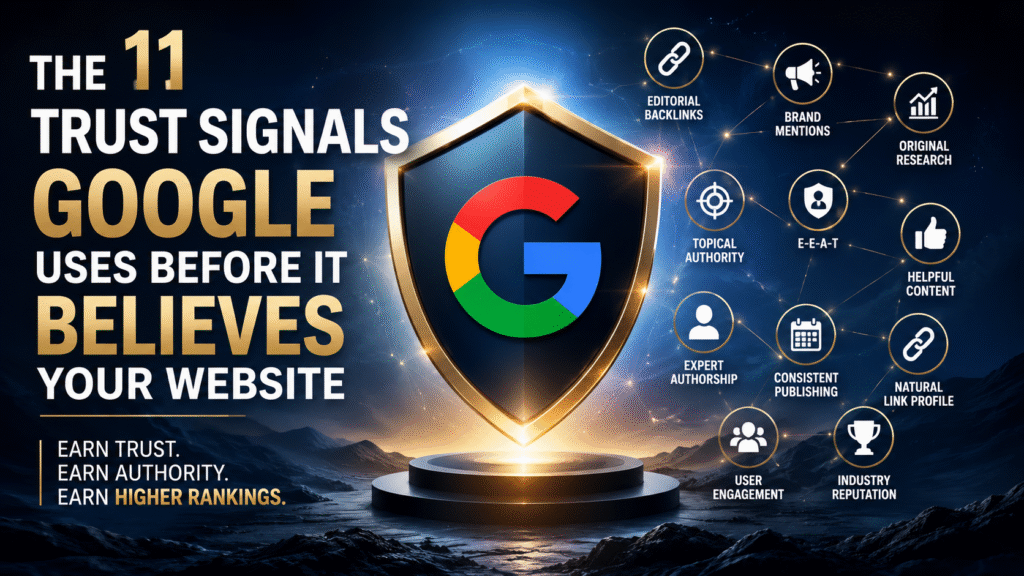
Instead, it looks for independent proof that a business deserves to rank using trust signals. From editorial backlinks and expert authorship to brand reputation and helpful content, these are the 11 trust signals Google uses before it believes your website.
Why Does Google Use Trust Signals?
Google evaluates a site much like a scout watches a baseball player. They don’t just look at one home run. They check the player’s history, their technique, and what other coaches say about them.
In December 2022, Google even added “Experience” to its famous quality framework, now known as E-E-A-T. This change means the system now looks for proof that a writer has actually used the product or lived the life they are describing.
It is a night and day difference from the old days of keyword stuffing.
The following sections explain how a website can prove its worth through eleven specific pillars of credibility. This guide covers everything from the power of news mentions to the importance of original research that robots cannot fake.
By the end, you’ll understand that ranking is about showing the world that a business is real, reliable, and respected by others in its field.
Key Insight: Trust is the most important part of Google’s evaluation framework because it proves a business is safe for users to visit.
1. How Editorial Backlinks Prove Your Real-World Value
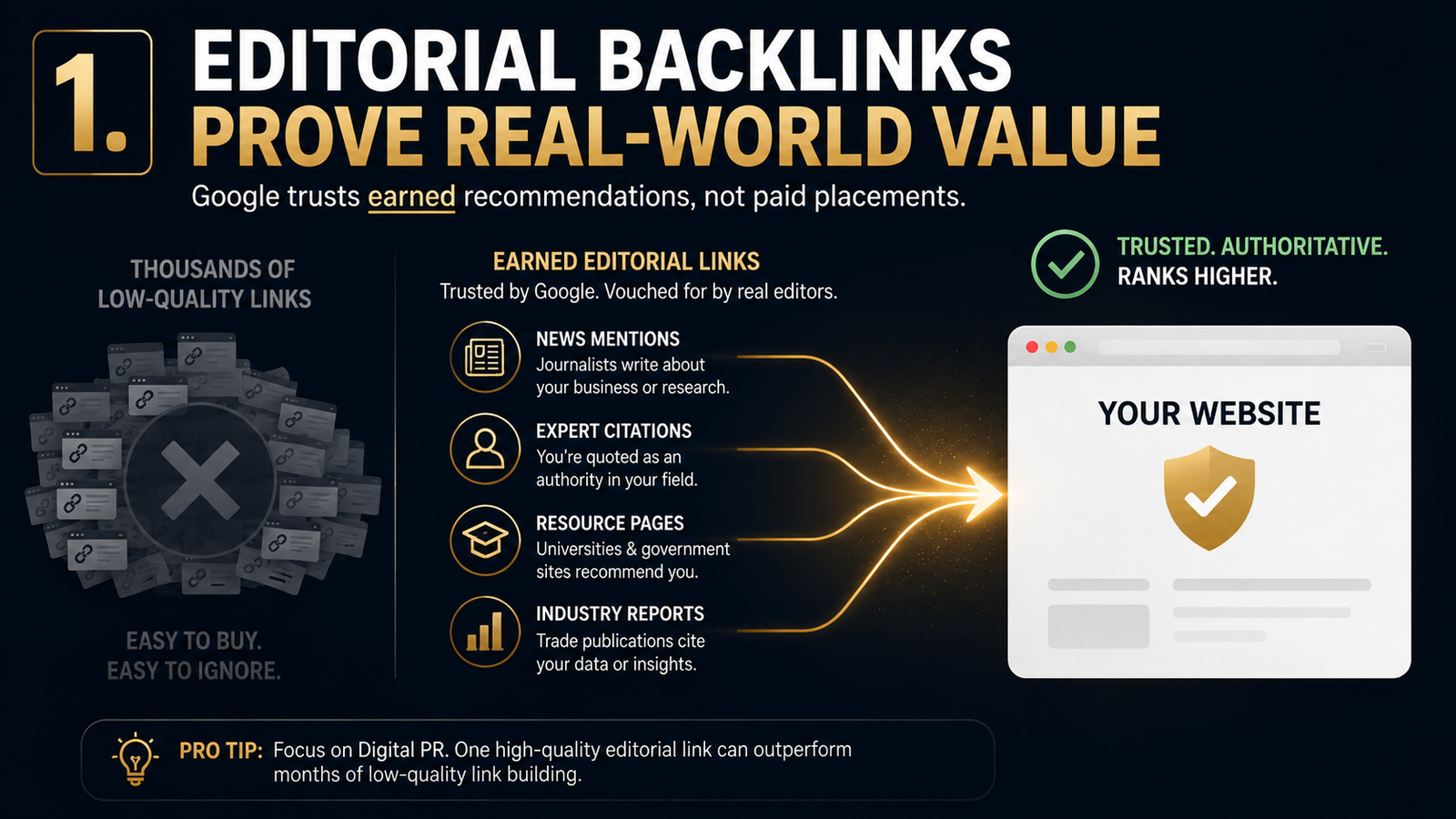
A single link from a high-authority domain like Wikipedia or the BBC carries more weight than ten thousand entries from automated directories.
Google views these as digital votes of confidence that cannot be purchased or faked through standard advertising channels. While many beginners obsess over the sheer number of links, the algorithm is actually hunting for signs of editorial judgement-the moment a real human editor decides your content is worth citing.
The Power of Earned Recommendations over Advertisements
Google distinguishes between links you “built” and links you “earned.”
An earned link occurs when a journalist or industry peer finds your data so compelling they use it as a primary source. This is essentially a public recommendation, which functions differently than a paid placement or a banner ad that anyone with a credit card can secure.
I have seen businesses spend thousands on “guest post packages” only to see zero movement in rankings because the link diversity patterns looked artificial.
Google’s systems are designed to detect these footprints. They prefer a natural growth profile where various respected domains link to you over a long period. It’s the difference between a high school athlete getting a scout’s attention versus a parent paying for a billboard to promote their kid.
Pro Tip: Focus on “Digital PR” by reaching out to journalists with unique insights rather than buying bulk links; a single citation as an expert source can do more for your authority than a year of low-quality outreach.
Quality and Diversity in Your Link Profile
When highly trusted domains transfer authority to your site, they are effectively vouching for your legitimacy.
This transfer helps Google verify that you aren’t just another site on the web, but a recognized entity in your field. While these direct hyperlinks are the gold standard, it is worth noting that real brands often get talked about even without a clickable URL, a concept known as an unlinked brand mention.
- Journalist Citations: Being quoted as an expert in a news story.
- Resource Page Inclusion: When a university or government site lists you as a helpful tool.
- Editorial News Mentions: Natural coverage of your company’s milestones or research.
- Industry Reports: When trade publications cite your proprietary data.
Ultimately, a healthy profile shows a steady stream of new referring domains from relevant industries.
If an accounting firm only has links from recipe blogs, Google’s “trust alarm” goes off. Relevance is the glue that makes an editorial backlink stick.
The concept of “implied links” suggests that Google’s understanding of a business extends far beyond the blue underlined text of a hyperlink.
While direct links are the gold standard, search engines have become adept at recognizing when a brand is being discussed in a positive or authoritative context elsewhere on the web.
Need Help Earning Editorial Links?
At (IOG) we specialise in securing DA60+ DoFollow editorial backlinks through 100% manual outreach on HARO and Qwoted. With 6 years of experience and over 10,000 placements delivered to SEO agencies and business owners worldwide, we know exactly what it takes to earn links that Google rewards. Visit our Link Order page here and get started today.
2. How Unlinked Brand Mentions Boost Credibility
Real brands get talked about naturally because they provide value, not just because they have a high-performing digital PR team.
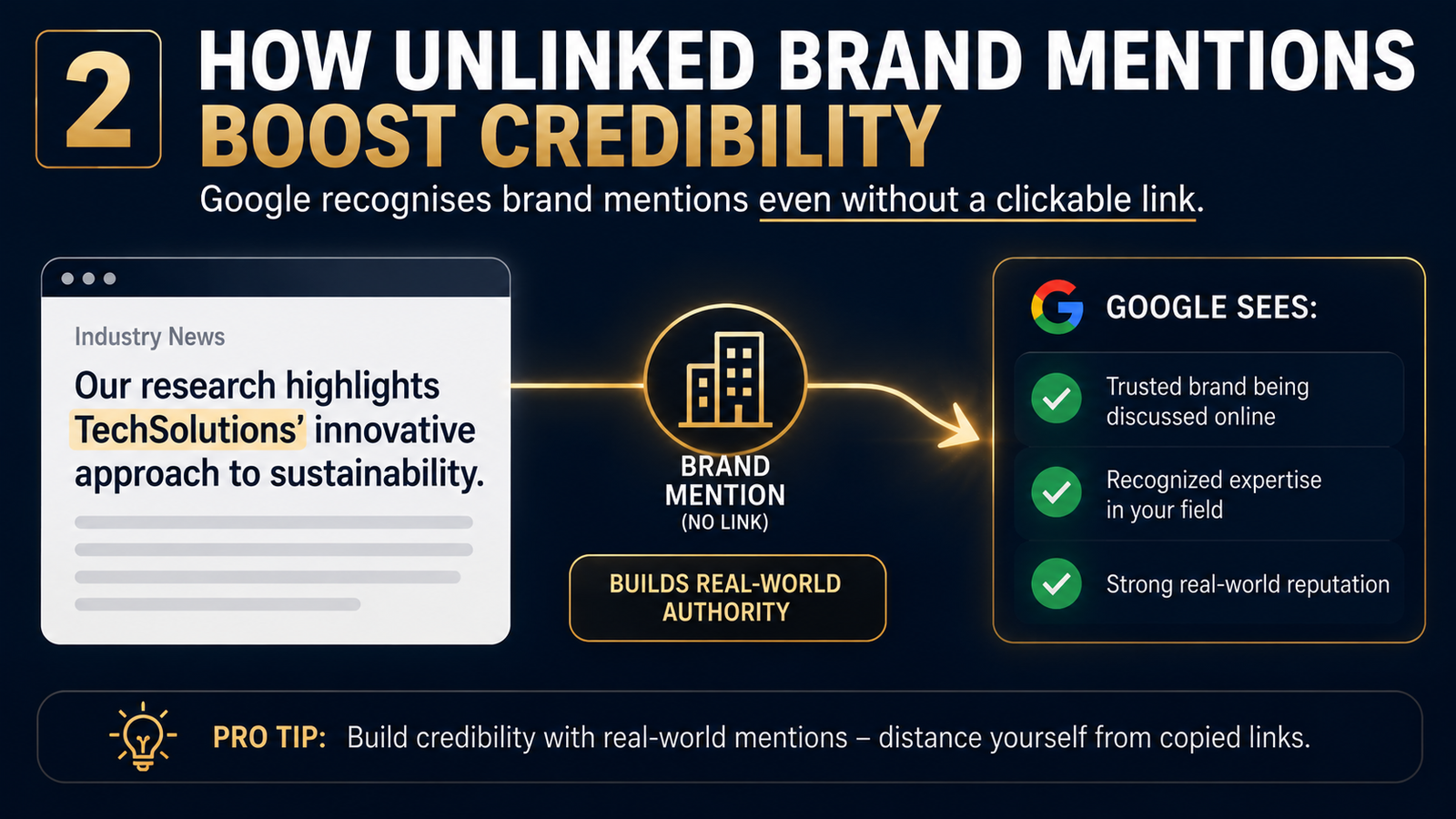
When a business name appears in news articles, podcast descriptions, or expert interviews without a direct link, Google still notes the association. These mentions act as a signal that the entity is a recognized player in its field.
Think of it like a professional athlete being discussed on a sports talk show. Even if the hosts don’t show a highlight reel, the mere mention of the player’s name in a specific context reinforces their status.
This logic applies to unlinked mentions across various platforms:
- News and Media: A citation in a local or national news outlet validates the business as a legitimate source of information.
- Social Discussions: Conversations on platforms like Reddit or industry-specific forums show that real people are engaging with the brand.
- Citations: Professional directories and industry lists often mention a company’s name and address, providing a “nudge” of legitimacy to search algorithms.
The Correlation Between Buzz and Trust
Google’s goal is to identify businesses that have earned recognition from others.
If a brand is frequently mentioned alongside specific keywords, it helps build topical authority. This often happens when a company produces original research or unique data that others find worth discussing.
Tracking these broader conversations allows Google to see a holistic view of a brand’s reputation.
A business that exists only within its own website and a few paid directories looks suspicious. Conversely, a brand mentioned across diverse, high-quality sources appears as a stable, trustworthy entity that users would likely find helpful.
3. How Original Research Earns Google’s Trust
Publishing a recycled “how-to” guide is the fastest way to become invisible in a sea of AI-generated noise.
While external mentions and links validate your existence, providing the world with information that didn’t exist yesterday is what proves you are a leader rather than a follower.
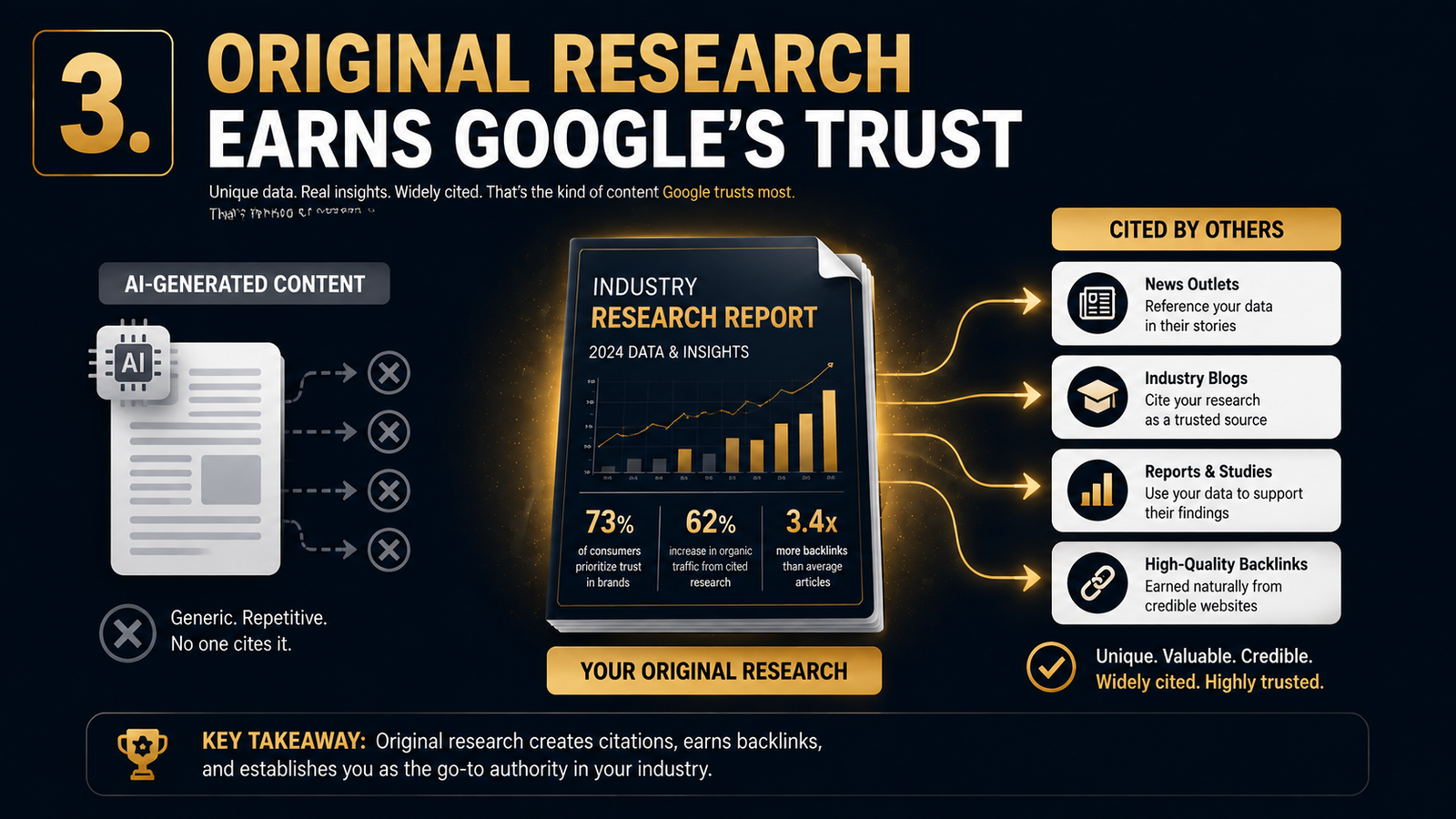
Google prioritizes content that offers unique insights because it represents a contribution to the global knowledge base. When a business publishes its own proprietary statistics or market data, it creates a primary source that others must cite, effectively turning the website into a lighthouse for the rest of the industry.
The Competitive Edge of Unique Data
Generic articles are easy to replicate. A survey of 500 industry professionals is not.
Because AI models are trained on existing data, they cannot hallucinate a case study involving your specific clients or a proprietary report based on your internal sales trends.
Key Takeaway: Original data is the ultimate “moat” because it is the only form of content that competitors and AI cannot legally or technically duplicate without giving you credit.
This commitment to original research signals to search engines that the site isn’t just another content farm. By crunching numbers and identifying new trends, the business demonstrates a level of subject matter expertise that goes beyond mere writing.
Examples of High-Value Research
- Industry Reports: Annual deep dives into pricing, consumer behavior, or technology adoption.
- Customer Surveys: Polls that reveal the “why” behind current market shifts.
- Internal Data Analysis: Anonymized trends pulled from your own software or service delivery.
- Experimental Results: “We tried X for 30 days” style tests that provide concrete proof of a strategy’s effectiveness.
Producing this level of depth requires a team to move past surface-level observations. It forces a brand to narrow its focus and master a specific niche, raising the question of how many different subjects a single site can truly dominate before its expertise starts to thin out.
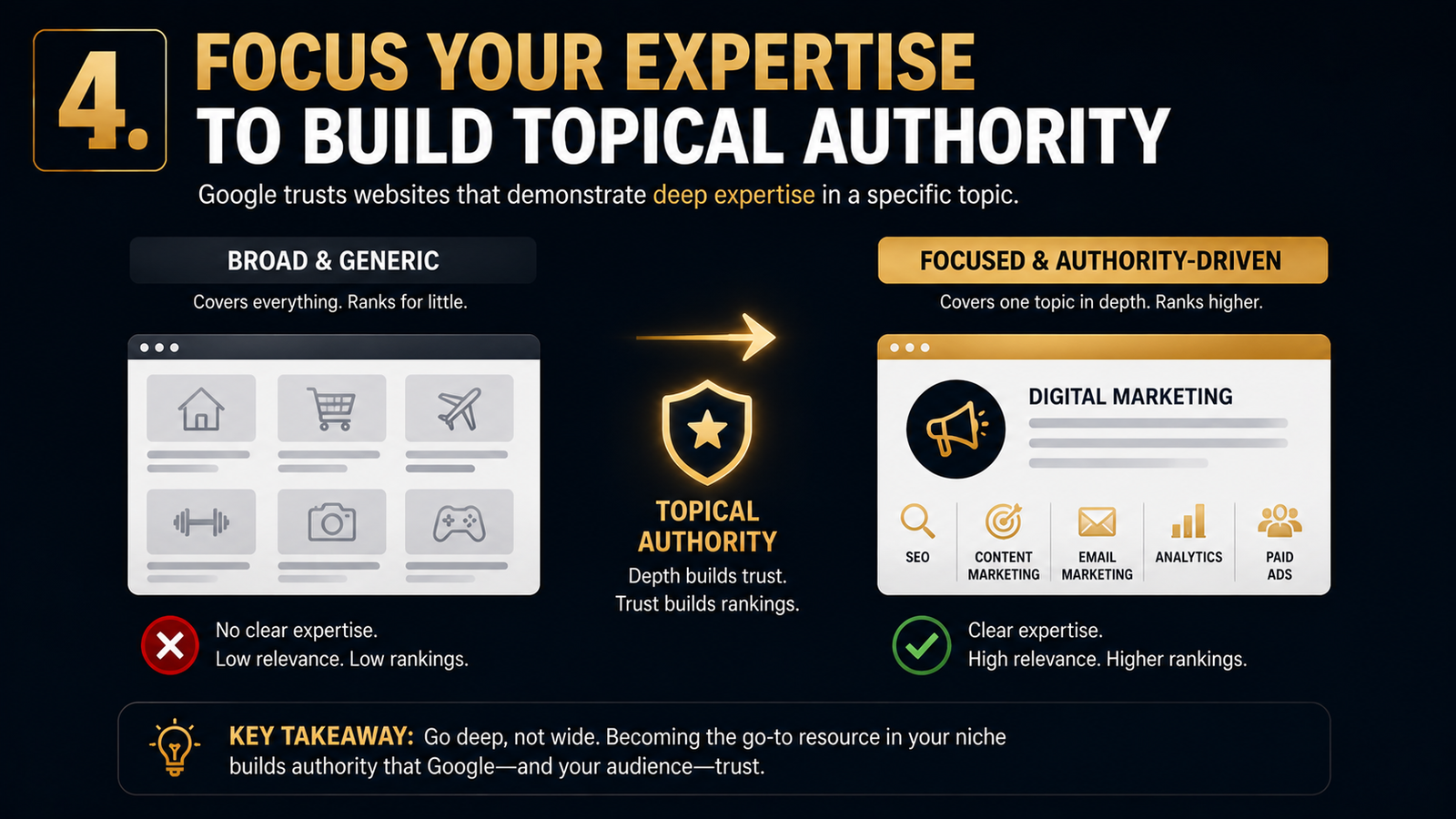
4. Focusing Your Expertise to Build Topical Authority
Google increasingly treats websites like specialized consultants rather than general-purpose encyclopedias.
In the early days of the web, a site could rank for almost anything by simply having more pages than the competition, but the algorithm has evolved to favor depth over mere breadth.
The Specialist Advantage
A website dedicated to forensic accounting that features 100 deep-dive articles on tax fraud and auditing will almost always outrank a general business blog that only mentions accounting in a handful of posts.
This happens because Google recognizes a comprehensive understanding of a subject area through the sheer density of related information.
When a site covers every possible sub-topic within a niche-from basic definitions to advanced case studies-it signals to the algorithm that the source is a primary authority.
It is the difference between a person who knows a little bit about everything and a master who knows everything about one specific thing.
Building Content Clusters
Creating this authority requires a shift toward content clusters.
This strategy involves creating a central “pillar” page that provides an overview of a broad topic, which then links out to dozens of specific, supporting articles.
These internal connections help search engines map out the site’s expertise, proving that the information isn’t just a collection of random facts.
I have seen many businesses fail because they try to “boil the ocean” by writing about every industry trend.
Skip the broad topics that every competitor covers. Instead, pick a specific corner of your market and exhaust it. This exhaustive coverage is what separates a trusted industry leader from a digital hobbyist.
This deep level of focus serves as a primary pillar for the E-E-A-T framework, which acts as the ultimate yardstick Google uses to measure whether a website is actually qualified to give advice on a given subject.
The August 2018 “Medic Update” proved that Google prioritizes a specific quality framework over raw link counts, rewarding websites that satisfy four distinct trust pillars.
While many chase individual ranking factors, seasoned strategists view these pillars as a collective lens through which Google’s human quality raters view the web.
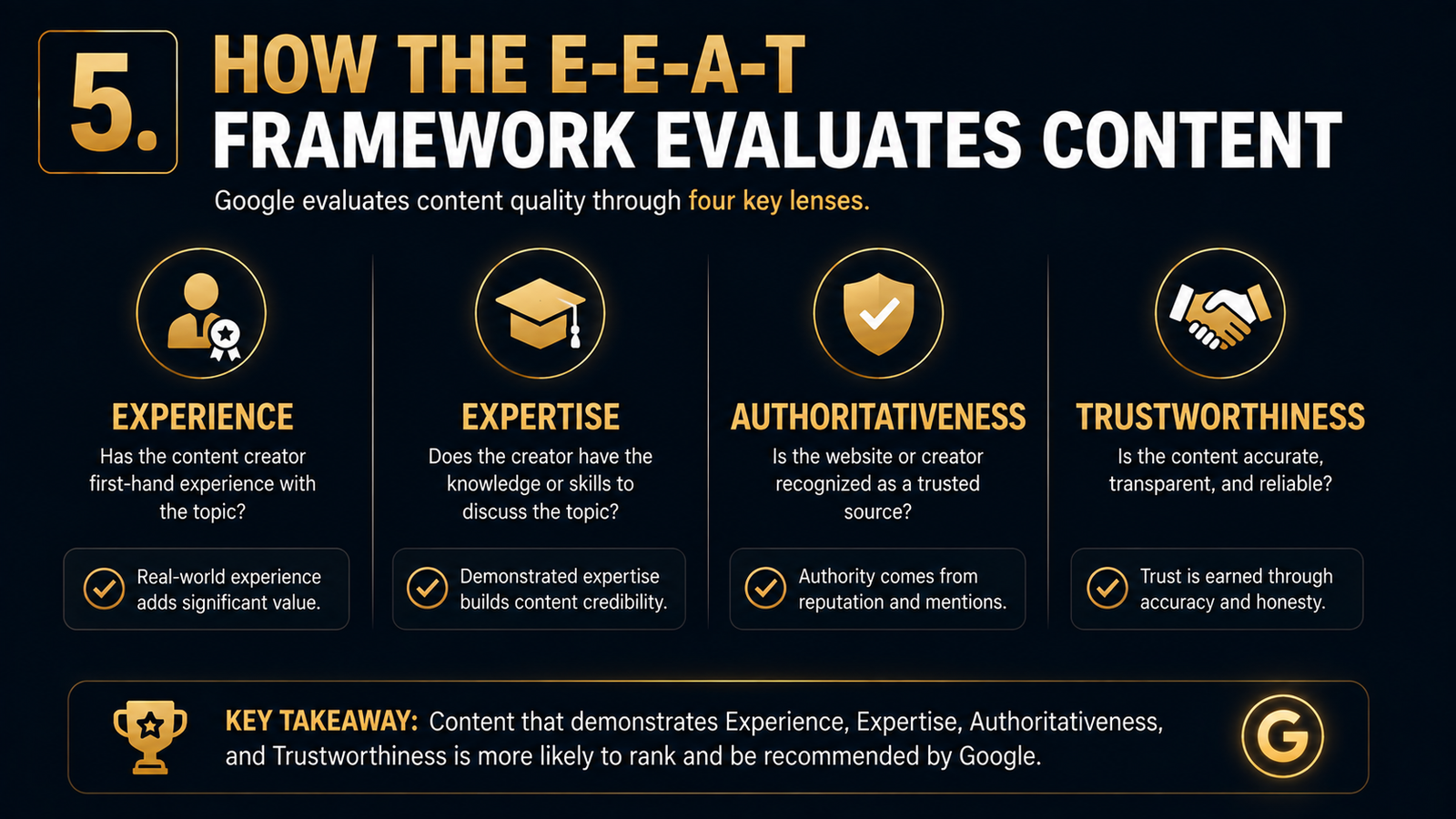
5. How the E-E-A-T Framework Evaluates Content
Google introduced E-A-T in 2014, but the landscape shifted in December 2022 when “Experience” was added to the mix. This framework is a central pillar of the September 2025 edition of the Search Quality Rater Guidelines, used to assess whether a page provides genuine value or just noise.
| Pillar | Core Requirement | Critical For |
|---|---|---|
| Experience | First-hand involvement | Product reviews and travel |
| Expertise | Topical skills and knowledge | Medical and legal advice |
| Authoritativeness | Industry reputation | News and government data |
| Trustworthiness | Accuracy and transparency | E-commerce and finance |
Defining the Four Pillars
Experience focuses on whether the creator has actually used the product or lived the situation. Google looks for evidence of first-hand involvement rather than a summary of someone else’s work. Expertise measures the creator’s formal or informal credentials. While a hobbyist can have expertise in gardening, “Your Money or Your Life” (YMYL) topics like health and safety require professional qualifications.
Authoritativeness is about the website’s standing in the broader industry. It reflects how much other experts look to the site as a definitive source of truth. Finally, Trustworthiness is the most critical signal of the group. It is measured through clear privacy policies, honest correction logs, and accessible contact information.
The Architecture of a Trusted Entity
A website’s reliability often hinges on technical transparency. Detailed author pages featuring professional credentials and social media links help Google verify that a real human stands behind the claims. This verification process ensures that the framework isn’t just a checklist, but a method for identifying helpful content that solves real-world problems for users.
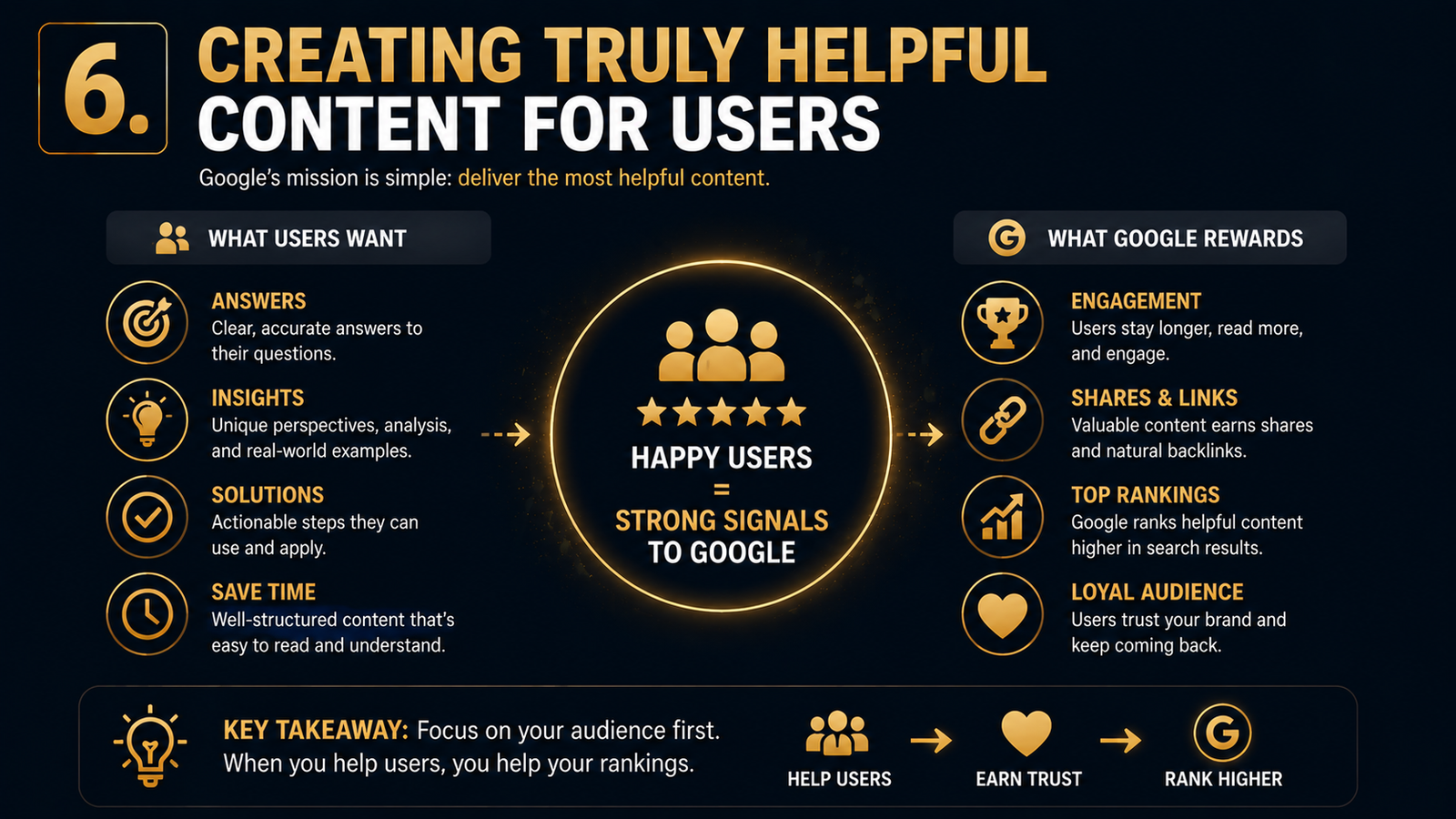
6. Creating Truly Helpful Content for Users
Google has shifted its focus toward rewarding content that prioritizes people over search engine algorithms.
While technical checkboxes matter, the real goal is providing a page experience that leaves a visitor feeling they actually learned something useful.
Countless sites lose half their traffic overnight because they focused on keyword density instead of solving a reader’s specific problem.
Solving Problems with Originality
Helpful content must offer unique insights rather than simply echoing what is already on page one of the search results.
If a site merely paraphrases a competitor’s article, it fails to demonstrate the “Experience” portion of the framework we discussed earlier. Google values content that answers real-world questions clearly and covers topics thoroughly without adding unnecessary fluff.
To avoid content that feels AI-generated or hollow, creators should include proprietary statistics or specific anecdotes from their professional history.
A guide on fixing a leaky faucet is far more trustworthy when it mentions the specific brand of wrench that usually snaps, rather than giving generic “step-by-step” advice. This depth signals to Google that the page exists to help, not just to capture a click.
Expert Insight: Skip the 2,000-word “ultimate guides” if the user’s question can be answered in two clear sentences; Google now penalizes “word count padding” that wastes a reader’s time.
Matching Search Intent
High-quality content must align perfectly with what the user actually wants to achieve.
If someone searches for “how to bake sourdough,” they want a recipe and timing charts, not a 3,000-word history of wild yeast in ancient Egypt.
Addressing search intent means anticipating the next question the reader will have and answering it before they have to click the “back” button.
- Does the page provide a clear, direct answer to the primary query?
- Is the information supported by first-hand involvement or specialized knowledge?
- Will the reader leave feeling they need to search again to find better details?
- Does the layout make the most important information easy to find quickly?
By focusing on these user-centric signals, a business proves its legitimacy.
This level of care often leads to the next layer of trust: identifying the specific human being behind the keyboard. Content is often judged by who created it, and establishing expert authorship is the logical next step in proving your site is a reliable resource.
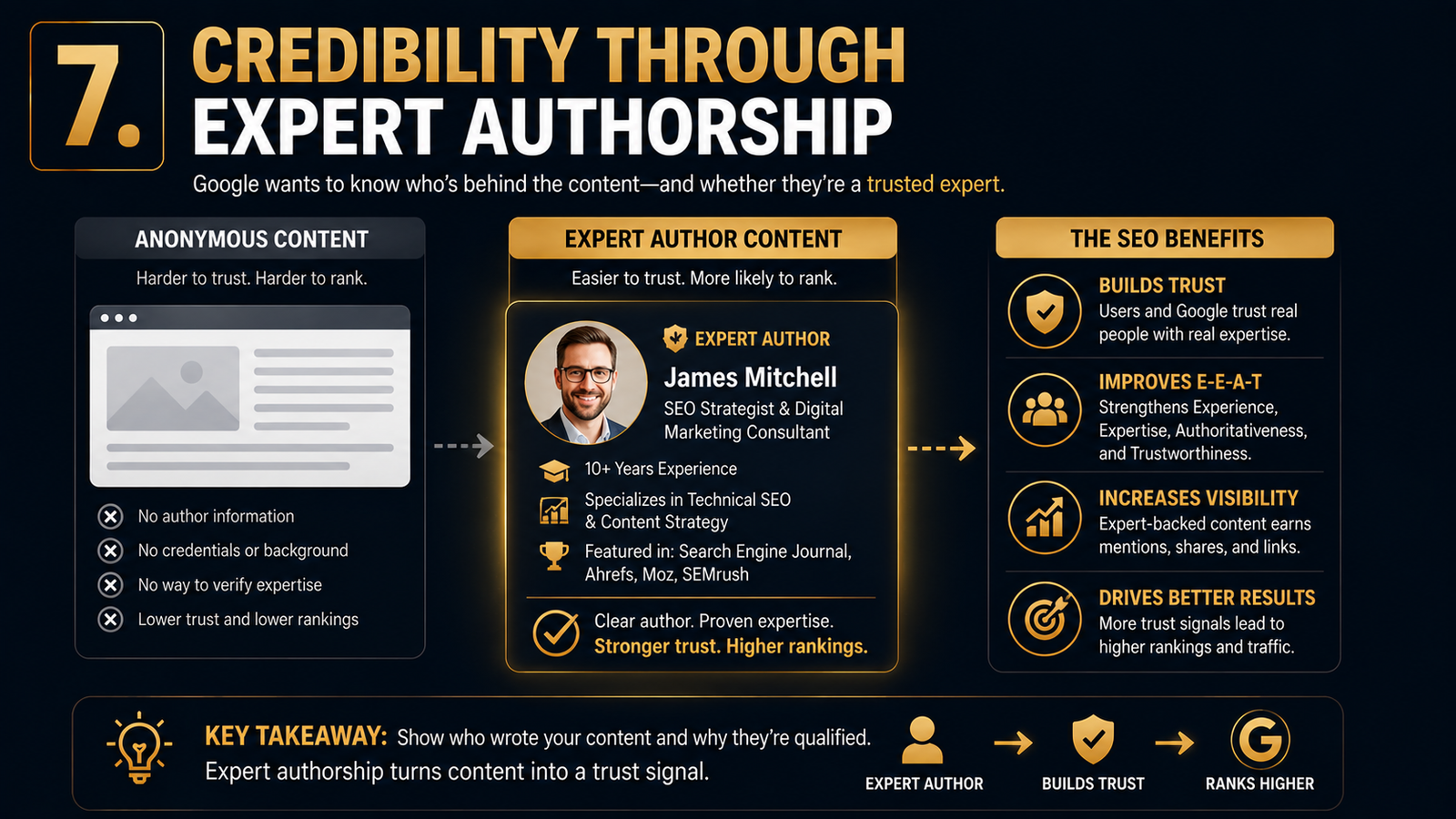
7. Credibility Through Expert Authorship
Anonymous content is a liability in an era where Google treats transparency as a non-negotiable trust signal.
If a website publishes medical advice or financial strategies without a named author, it effectively tells the algorithm that no one is willing to stand behind the information.
Expert authorship is about providing a verifiable trail of subject matter expertise that proves the writer has the right to speak on the topic.
The Anatomy of a High-Trust Author Profile
Google’s automated systems look for specific markers to verify that an author is a real person with legitimate credentials.
A simple byline is no longer enough to satisfy the need for accountability. To move the needle, an author page must function like a professional resume that both humans and bots can parse easily.
- Professional Credentials: List relevant degrees, certifications, or licenses, especially for topics impacting a reader’s safety or finances.
- Real-World Experience: Describe years in the industry or specific projects that demonstrate first-hand involvement in the field.
- External Validation: Include links to the author’s social media profiles (like LinkedIn) and other reputable publications where they have been featured.
- Contact Information: Provide a clear way to reach the author or the editorial team to ensure transparency and accountability.
Why Accountability Outranks Clever Prose
Sites struggle because they prioritize “voice” over verifiable expertise.
In our experience, a dry article written by a certified public accountant will outrank a flashy one written by a ghostwriter every time.
Google uses these author signals to filter out “content farms” that churn out generic text without any real-world stakes.
Establishing this level of trustworthiness requires more than a 50-word bio at the bottom of a post.
It involves creating dedicated author pages that aggregate all of a writer’s work, proving they are a consistent voice in their niche.
While a single expert can anchor a site’s credibility, the real magic happens when a brand maintains a steady rhythm of high-quality output from multiple recognized specialists over time.
Reliability is the heartbeat of search engine trust.
While a single masterpiece might earn a temporary spike in attention, Google looks for a sustained pattern of value to confirm a website isn’t a “one-hit wonder” or a dormant domain. A ghost town of a blog suggests a business has moved on, whereas a steady stream of fresh, useful material signals an active, thriving operation.
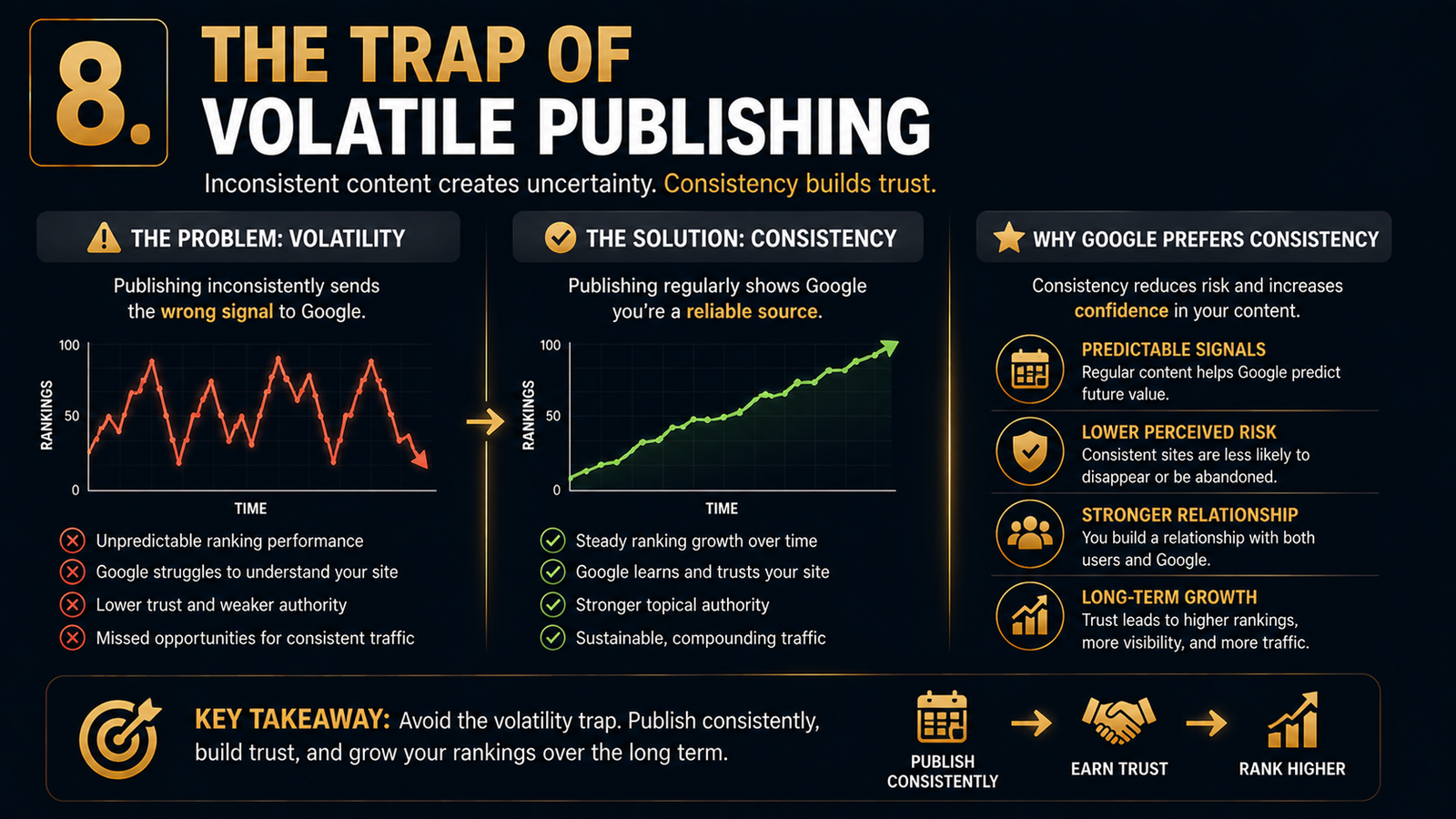
8. The Trap of Volatile Publishing
Many businesses fall into the “burst” trap, publishing ten articles in a week and then going silent for three months.
This inconsistency is a massive red flag. Search engines prefer a predictable cadence because it demonstrates a long-term commitment to serving the audience. If a site stops updating, its relevance begins to decay, especially in fast-moving industries where yesterday’s advice is today’s error.
Consistency does not mean high volume.
A small team publishing one high-quality, deeply researched piece every two weeks is far more effective than a content farm churning out daily fluff. Google’s systems are designed to distinguish between freshness that adds value and “update-bait” that merely changes a date stamp without improving the substance.
Pro tip: If you cannot maintain a weekly schedule, pivot to a “quality over frequency” model where you update your most successful existing pages quarterly to keep the data accurate.
Proving Ongoing Expertise
Every new post is an opportunity to reinforce topical authority.
By covering a subject from multiple angles over several months, a creator proves they have more than just a surface-level understanding. This temporal proof is something AI-generated spam struggles to replicate, as those sites often appear overnight and vanish just as quickly when the algorithm catches up.
| Strategy | Impact on Trust | Google’s Perception |
|---|---|---|
| Sporadic Bursts | Low | Unreliable/Unstable |
| Daily Thin Content | Very Low | Potential Spam/Farm |
| Consistent Quality | High | Subject Matter Authority |
This steady output does more than just appease an algorithm; it creates a trail of breadcrumbs that other reputable websites eventually follow. When a site becomes a dependable source of truth, it naturally starts to attract the kind of high-caliber endorsements that no amount of manual outreach can buy.
Link diversity patterns reveal the difference between a website that has earned its place and one that has bought it.
While a single high-profile mention is a win, Google looks for a varied ecosystem of digital endorsements to confirm a site’s legitimacy. A natural profile mimics the messy, unpredictable reality of the internet rather than a sanitized, artificial spreadsheet of “perfect” placements.
The Anatomy of Organic Growth
Genuine websites attract attention from various sources, ranging from industry-specific blogs to mainstream news outlets.
This variety suggests that the content is being discovered organically by different types of people for different reasons. A site that only has links from one specific niche-or worse, only from “guest post” sites-looks like a manufactured link scheme to an algorithm trained to spot manipulation.
A healthy profile typically includes several key characteristics:
- Varied Anchor Text: Instead of every link using the same keyword, natural links use brand names, raw URLs, or phrases like “this report” or “click here.”
- Different Referring Domains: Getting ten links from ten different websites is vastly more powerful than getting 100 links from a single domain.
- Industry Relevance: While a few “off-topic” links are normal, the core of the profile should come from industries related to the site’s expertise.
- Steady Growth: Trust is built through a consistent upward trajectory of new mentions, rather than a suspicious spike of 500 links in a single weekend.
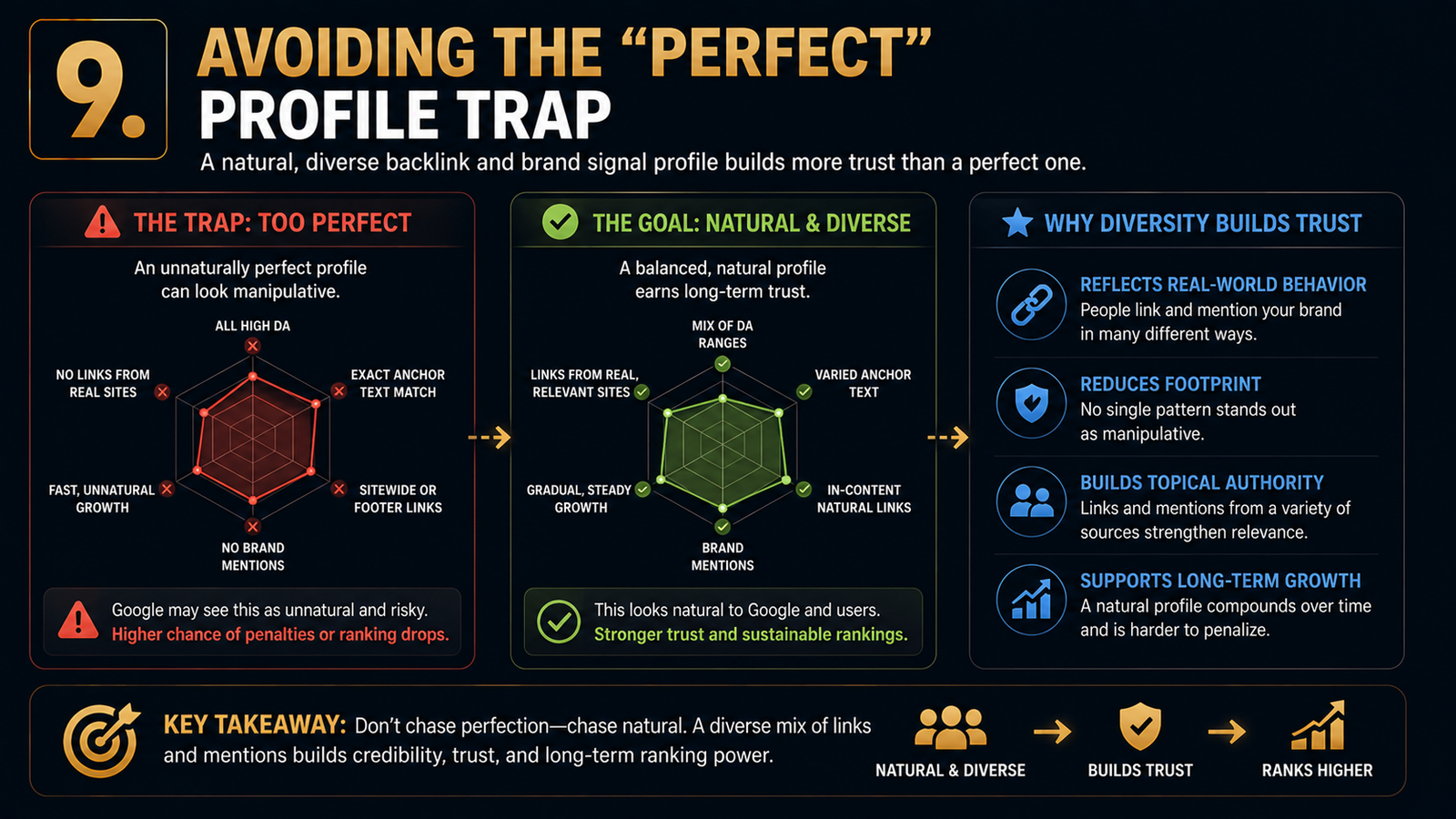
9. Avoiding the “Perfect” Profile Trap
There is no such thing as a “perfect” backlink profile, and trying to engineer one often backfires.
A site with zero “no-follow” links or only high-authority domains looks statistically impossible. Google recognizes that a real business will naturally pick up some lower-quality or irrelevant mentions along the way.
These are the “scars” of a real brand existing in the wild.
The pattern of these links serves as a digital trail of breadcrumbs. It proves that other humans found the information valuable enough to reference it without a commercial contract.
However, external validation is only half of the story. Even the most impressive collection of links cannot save a site if the people clicking those links immediately hit the “back” button in frustration.
User satisfaction acts as a silent endorsement that validates the structural and editorial trust signals established in earlier sections.
While Google does not assign a specific “trust score” based on a single click, it observes how people interact with a website to determine if the content genuinely solves their problems. When readers stay to finish a guide or return to a site for future queries, they provide behavioral evidence that the business is a reliable authority in its field.
Technical Foundations of a Good Page Experience
Google solidified the importance of user experience by introducing Core Web Vitals in May 2020.
These metrics moved from being general suggestions to official ranking factors in June 2021, focusing on how quickly and smoothly a page functions for a real person.
Despite their importance, as of July 2025, only 44% of WordPress sites on mobile successfully pass all three tests, leaving a significant opportunity for businesses to stand out by prioritizing technical health.
| Metric | What It Measures | Target Score |
|---|---|---|
| LCP | Loading performance (Largest Contentful Paint) | 2.5s or faster |
| CLS | Visual stability (Cumulative Layout Shift) | Less than 0.1 |
| INP | Responsiveness (Interaction to Next Paint) | Under 200ms |
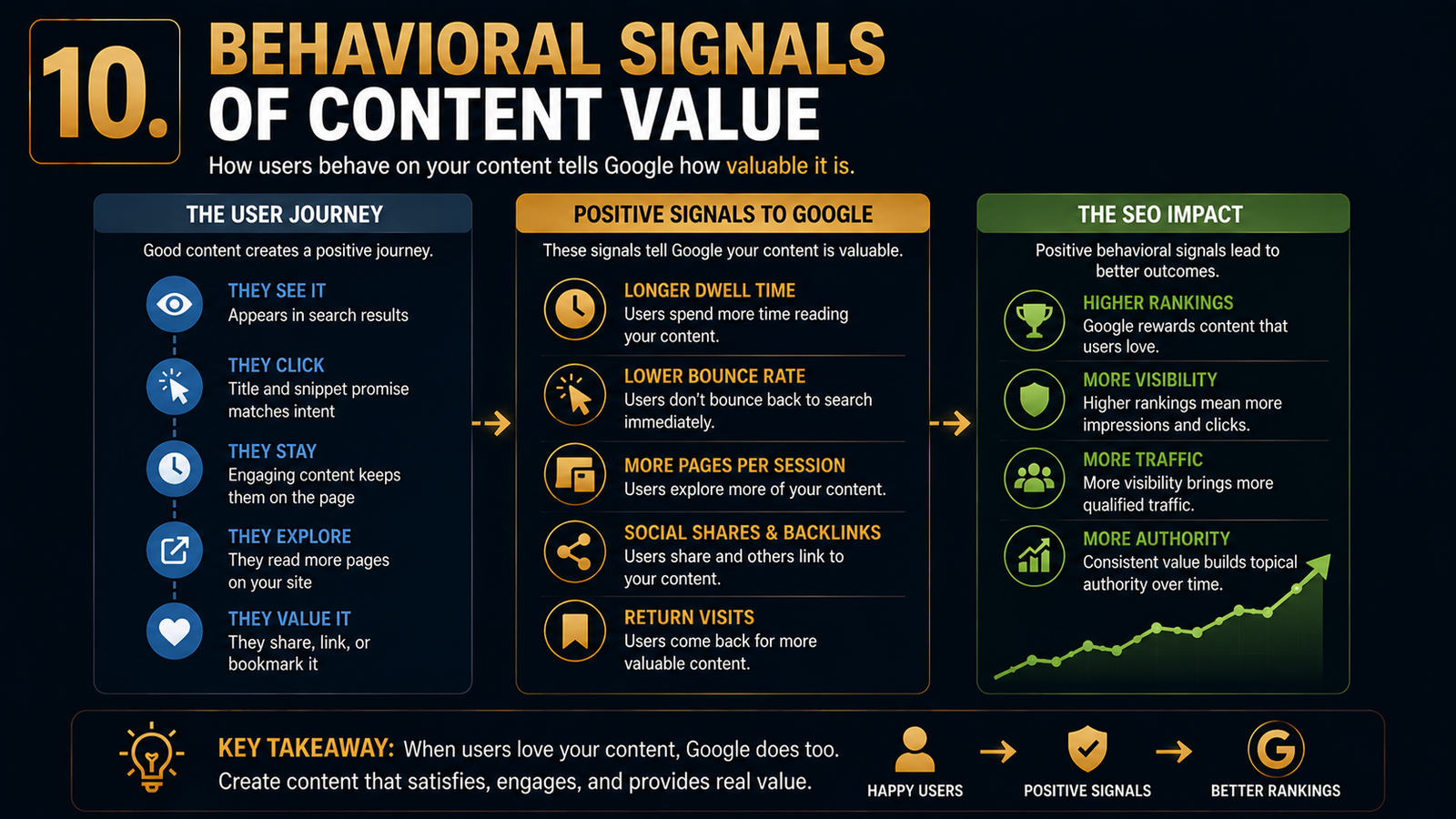
10. Behavioral Signals of Content Value
The goal isn’t to “game” specific engagement numbers but to create an environment where positive behaviors happen naturally. Many sites focus so hard on keywords that they forget to make the text readable, resulting in users bouncing back to search results immediately.
High-trust websites encourage visitors to engage with useful content through clear internal links and expert-led insights that satisfy the original search intent.
- Deep Reading: Users spending minutes on a page rather than seconds.
- Repeat Visits: People returning directly to the site for new information.
- Interaction: Clicking on resource links or using on-site tools.
- Low Bounce Rates: Visitors finding exactly what they expected upon arrival.
A business’s reputation in the broader industry also plays a significant role in how Google assesses these interactions. If a site is known for accuracy, users are more likely to stay and engage.
Ultimately, these metrics serve as the final proof that the expertise and authority claimed in previous sections are being successfully delivered to the audience.
A business that exists only within the vacuum of its own domain is rarely a business that Google fully trusts.
While on-page signals and user interactions provide a window into a site’s quality, the ultimate validation comes from how the real world perceives the brand when the website isn’t even in the room.
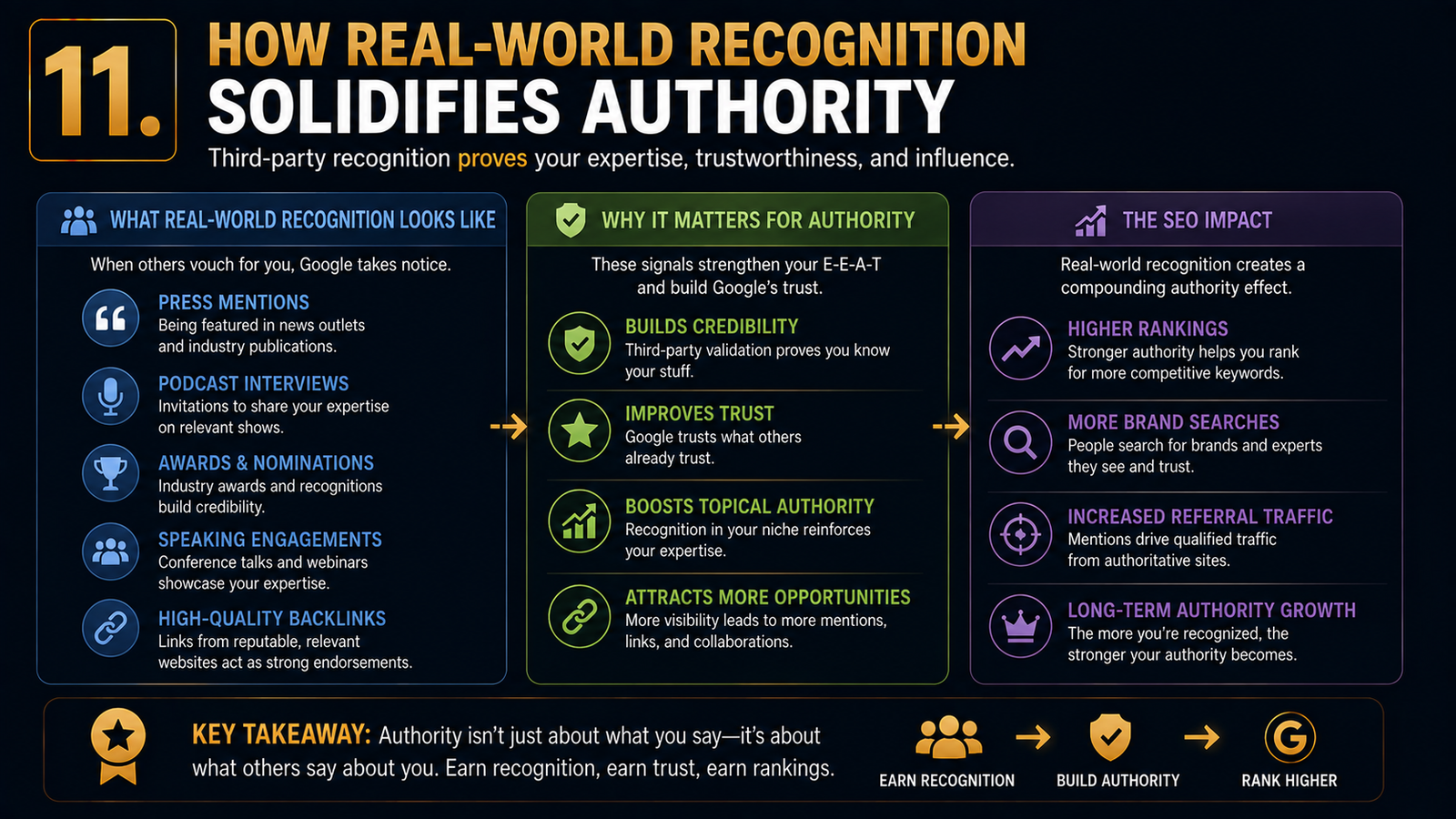
11. How Real-World Recognition Solidifies Authority
Google’s objective is to mirror human reality, and in the real world, industry reputation is built through third-party verification.
When a company is cited in respected publications or mentioned by professional associations, it signals to search engines that the entity is a legitimate player in its field rather than a digital ghost.
The Power of External Validation
Search engines look for evidence of your brand’s footprint across the broader web to confirm you are who you say you are. This external proof acts as a safety net, ensuring that the expertise displayed on your blog is backed by actual peers and institutions.
- Industry Awards: Winning or being shortlisted for recognized honors provides objective proof of excellence.
- Speaking Engagements: Having team members invited to present at trade shows or conferences demonstrates high-level expertise.
- Professional Memberships: Active participation in groups like the Better Business Bureau or niche-specific guilds confirms accountability.
- Media Interviews: Features in news outlets or guest appearances on industry podcasts serve as powerful social proof.
The Impact of Customer Reputation
Beyond professional accolades, the collective voice of the consumer serves as a primary trust signal.
Positive user reviews on platforms like Google Business Profile or TrustPilot establish a website as an expert voice by providing a track record of reliability. These testimonials are difficult to fake at scale and offer the behavioral evidence Google needs to verify that your business delivers on its promises.
Ultimately, Google wants to identify businesses that have earned recognition from others.
By cultivating a strong offline presence and securing mentions in authoritative spaces, you transform your website from a mere collection of pages into a trusted industry pillar.
Conclusion
Google does not use a single “trust score” to rank a website, but it does use hundreds of individual signals to decide if a business is the real deal. These signals act like a digital background check.
If a website lacks clear authorship, original data, or a history of being mentioned by others, it remains a stranger to the search engine. Trust is the most critical part of the E-E-A-T framework because even the most expert advice fails if the source seems shady.
Key Takeaways for Building Credibility
- Real-world recognition beats technical tricks. Mentions in news articles, podcasts, and industry reports prove a brand exists outside its own server.
- Expertise must be visible. Detailed author biographies with professional credentials help Google verify that a human with actual experience wrote the content.
- Performance is a trust signal. Technical health matters, as only 44% of WordPress sites currently pass all three Core Web Vitals tests on mobile devices.
- Authenticity is not optional. Providing a physical address, a clear privacy policy, and public Whois information separates legitimate businesses from temporary spam sites.
Author Bio
IOG has been securing powerful Editorial Backlinks for businesses and Agencies for over 6 years with 10,000+ placements secured. Our qualified professionals work with businesses across the globe to deliver practical insights and strategies that drive real results. We’re committed to creating content that helps business owners make informed decisions and grow their operations.