

A single Editorial Backlink from a major news site like The New York Times or a niche authority like TechCrunch can outweigh thousands of low-quality forum posts in the eyes of Google’s ranking algorithm. This reality stems from how search engines view “votes” of confidence on the web. When a reputable editor chooses to link to a piece of content because it adds value to their story, they provide an editorial backlink. These are not bought, traded, or hidden in a sidebar; they are earned endorsements that signal to Google that a website is a trusted leader in its field.
The stakes for understanding these links have never been higher for businesses trying to reach the first page of search results. While Google has updated its systems hundreds of times to catch spam, the core principle of authority remains a pillar of SEO rankings. People often wonder if the rise of artificial intelligence and social media has made traditional link building obsolete. However, data suggests that the relationship between high-quality links and visibility is stronger than ever for those who play by the rules.
Editorial Links And Rankings
Backlinko’s analysis of 11.8 million Google search results found that the number of domains linking to a page was the factor that correlated most strongly with high rankings. This study highlights that Google still relies on the “neighborhood” a website lives in to determine its worth. If a site is surrounded by mentions from respected industry leaders, Google treats it as a reliable source. If it only has links from obscure, unrelated blogs, the algorithm may view it with suspicion or ignore it entirely.
This article examines the mechanics of how editorial links influence the way Google crawls, indexes, and trusts a website. The reader will learn why these links act like a digital “seal of approval” from an expert witness. By looking at official statements from Google and comparing them with large-scale industry studies, the following sections clarify why genuine editorial endorsement is the gold standard for modern SEO strategies.
“Links are still the best way we’ve found to discover how the rest of the world perceives a particular page.”
– Representative, Google Search Team
Understanding the difference between a “link scheme” and a natural editorial placement is the first step toward building a sustainable online presence. The following chapters break down the technical side of trust, the specific impact of authority on rankings, and the methods used to earn these placements without triggering Google’s spam filters. It is a shift from thinking about “quantity” to focusing on the “quality” of the digital company a brand keeps.
Editorial Backlinks Explained
Buying a mention in a link directory is a transaction, but receiving an editorial backlink is a vote of confidence. Unlike links that a site owner can generate themselves, these are placements given naturally by editors, journalists, or site owners because the content in question provides genuine value to their readers. They are the result of merit rather than a simple exchange of funds or a reciprocal agreement.
The distinction between these earned endorsements and manipulative tactics is central to white hat link building. While a user might encounter dozens of links daily, an editorial link stands out because it is embedded within the flow of an article to cite a source, provide data, or offer further reading. It is not tucked away in a footer or hidden in a sidebar alongside hundreds of unrelated URLs. This placement indicates that a human gatekeeper decided the link deserved to be there.
Defining the Editorial Difference
An editorial backlink occurs when a third-party website links to another site without being asked, paid, or coerced. This usually happens because the destination page contains a unique data set, a compelling infographic, or a definitive guide that helps the linking author prove a point. These links represent a transfer of trust that search engines use to determine which pages deserve the most visibility.
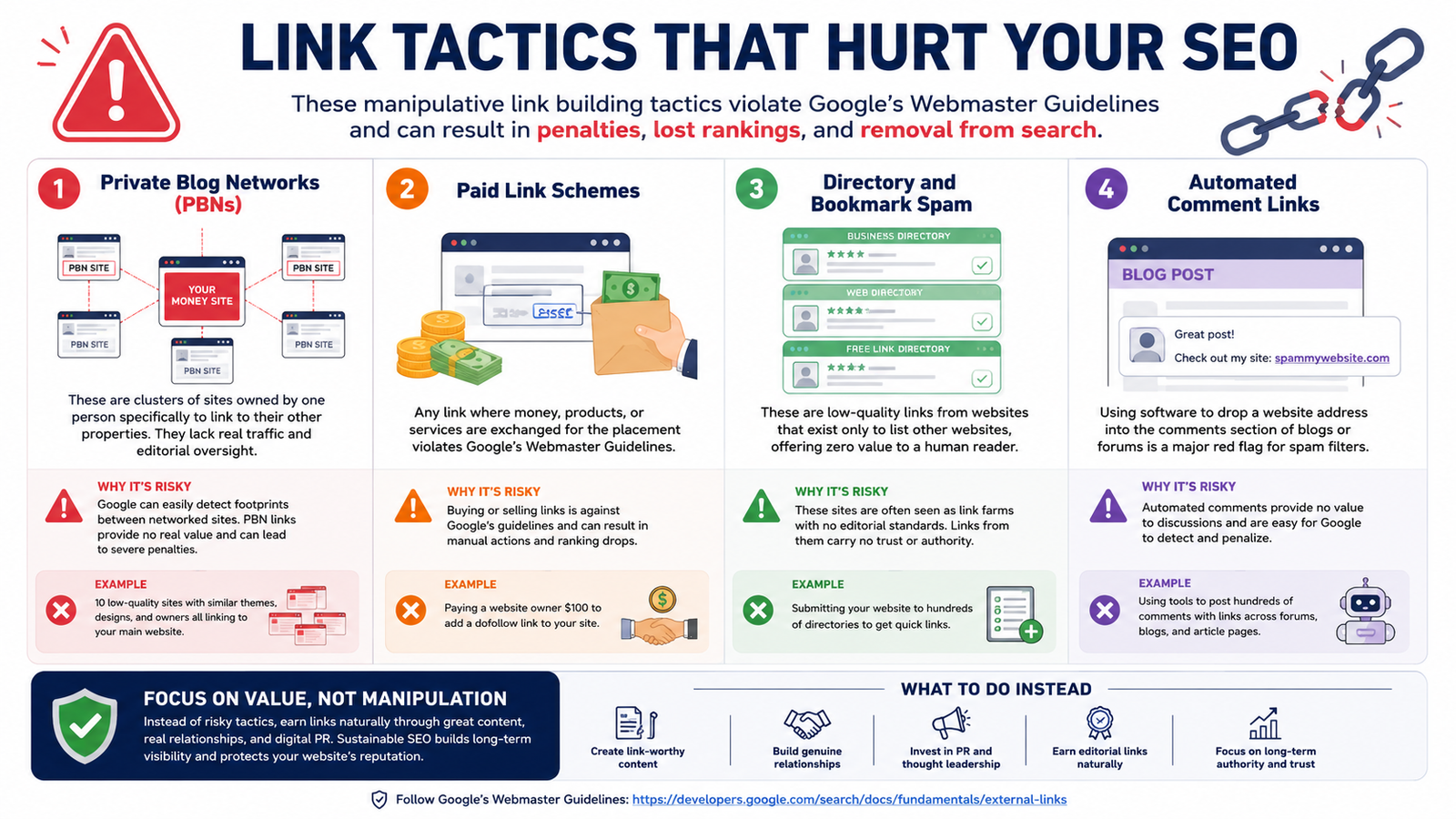
Contrast this with common manipulative tactics that often lead to search engine penalties. A clear hierarchy exists in the digital ecosystem, and not all connections are viewed with the same level of respect by modern algorithms:
- Private Blog Networks (PBNs): These are clusters of sites owned by one person specifically to link to their other properties. They lack real traffic and editorial oversight.
- Paid Link Schemes: Any link where money, products, or services are exchanged for the placement violates Google’s Webmaster Guidelines.
- Directory and Bookmark Spam: These are low-quality links from websites that exist only to list other websites, offering zero value to a human reader.
- Automated Comment Links: Using software to drop a website address into the comments section of blogs or forums is a major red flag for spam filters.
The Role of Content Quality
To earn these placements, a website must act as a primary source of information. When a journalist at a major publication needs to cite a statistic, they look for the original researcher. By providing that primary data, a site owner secures a link that is almost impossible to replicate through shortcuts. This process is how the algorithm begins to understand a site’s specific “neighborhood” and its standing among peers.
“The only way to consistently stay on the right side of algorithm updates is to focus on links that would still be valuable even if search engines didn’t exist.”
– SEO Industry Observation
93% of SEO experts agree that earned links are more durable than any other type. While a guest post might be removed or a directory might go offline, a link within a well-researched news article or a high-traffic resource page tends to stay active for years. This longevity provides a steady stream of authority that helps the algorithm process the relevance and reliability of the linked page over the long term.
Google’s Algorithm Values Trust
Google shifted from counting the quantity of votes to assessing the integrity of the voter more than a decade ago. While early versions of the algorithm were easily manipulated by repetitive patterns, the introduction of the Panda update in 2011 and the Penguin update in 2012 fundamentally changed how the system views external validation. These updates forced a transition toward rewarding sites that demonstrate genuine authority rather than those that simply accumulate a high volume of mentions.
The modern algorithm functions much like a peer-review system in a complex engineering field. It looks for signals of E-E-A-T (Experience, Expertise, Authoritativeness, and Trustworthiness) to determine which pages deserve the top spot. Because editorial links are granted by independent third parties based on the merit of the content, they serve as the primary mechanism for establishing these four pillars in the eyes of the search engine.
The Architecture of Authoritativeness
Google’s public guidance consistently highlights that natural links are the only ones that should exist. The search team has stated that any link intended to manipulate PageRank or a site’s ranking in Google search results may be considered part of a link scheme. This creates a clear divide: while a low-quality directory link offers no proof of expertise, a mention within a news article or a niche-specific journal acts as a verified credential.
Trust is not a single metric but a composite of several factors that the algorithm evaluates. When a reputable site references a source, it effectively “vouches” for the accuracy of that data. This relationship is a core component of how the algorithm maps the web’s neighborhoods of trust. Sites that are frequently cited by established leaders in their field eventually become recognized as leaders themselves, regardless of how many smaller, unrelated sites might be pointing at them.
How the Algorithm Measures Endorsement
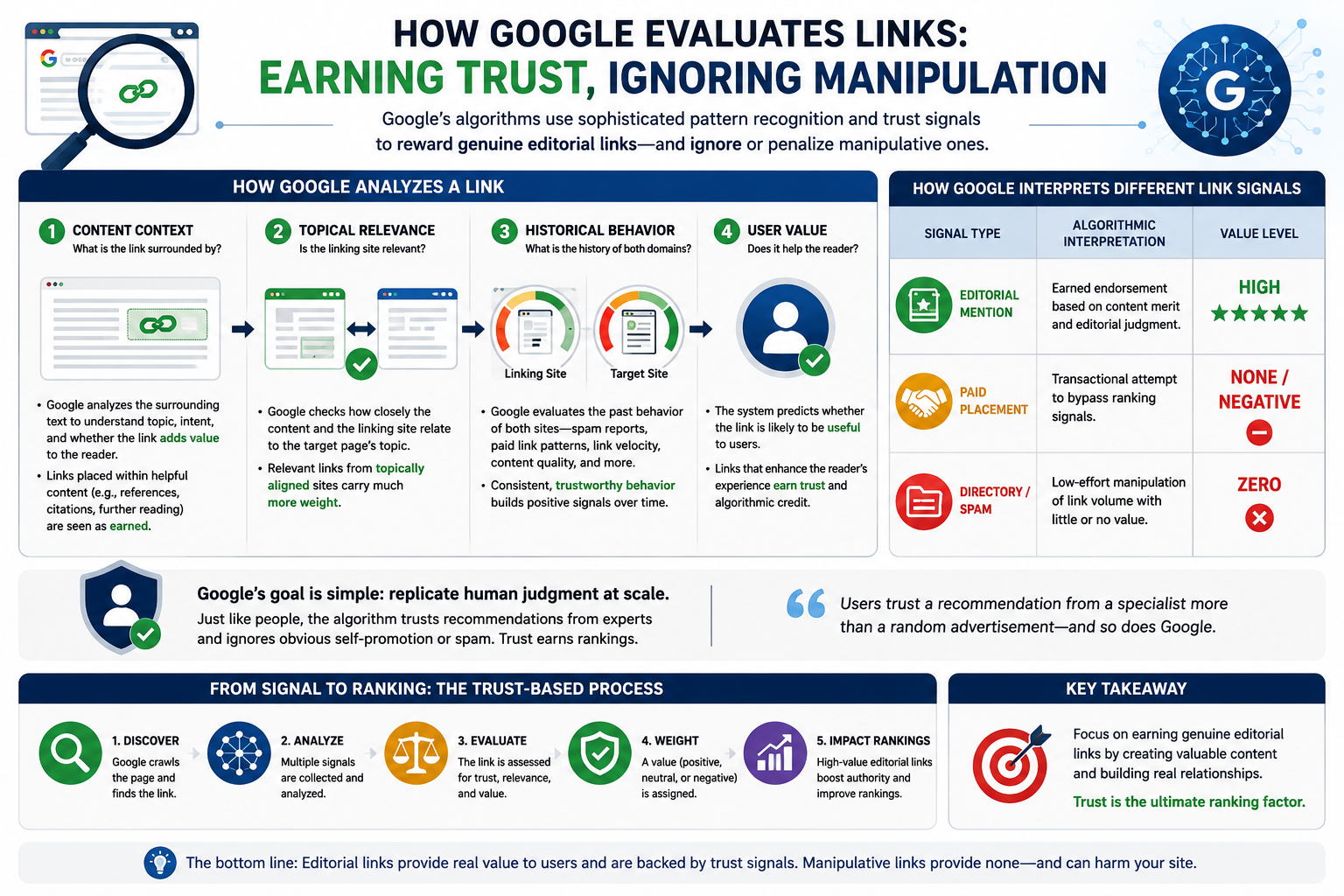
Google uses sophisticated pattern recognition to distinguish between a forced placement and a genuine editorial nod. The system analyzes the surrounding text, the relevance of the linking site, and the historical behavior of both domains. If a link appears in a context that provides value to the reader-such as a “further reading” suggestion or a citation for a statistic-it carries significantly more weight than a standalone link in a footer or sidebar.
| Signal Type | Algorithmic Interpretation | Value Level |
|---|---|---|
| Editorial Mention | Earned endorsement based on content merit. | High |
| Paid Placement | Transactional attempt to bypass ranking signals. | None/Negative |
| Directory/Spam | Low-effort manipulation of link volume. | Zero |
The engineering behind these evaluations is designed to mirror human behavior. Users trust a recommendation from a specialist more than a random advertisement, and the algorithm attempts to replicate this preference. This focus on human-centric trust signals sets the stage for quantitative research, where data scientists measure exactly how much these endorsements move the needle in live search results.
“Our goal is to provide users with the most relevant and authoritative results possible. This means prioritizing content that has been naturally recognized by others in its field.”
– Google Search Quality Guidelines
Skip the pursuit of bulk metrics unless the goal is a temporary spike followed by a manual penalty. The algorithm is now smart enough to recognize that true authority cannot be bought or automated; it must be built through a consistent history of providing value that others find worth sharing. This philosophical alignment between Google’s goals and editorial placements is why these links remain the most protected and effective signal in a modern SEO strategy.
Industry Studies Link Rankings
Data limitations often make it difficult for individual site owners to see the broader picture of how Google evaluates the web, but massive data crawls from industry leaders provide a clearer map. These large-scale analyses consistently show that while Google’s methods for identifying trust have become more sophisticated, the presence of external validation remains a primary differentiator between high-ranking pages and those that never see the light of day. When looking at the sheer volume of the web, the gap between the “haves” and “have-nots” of search traffic is almost entirely defined by these connections.
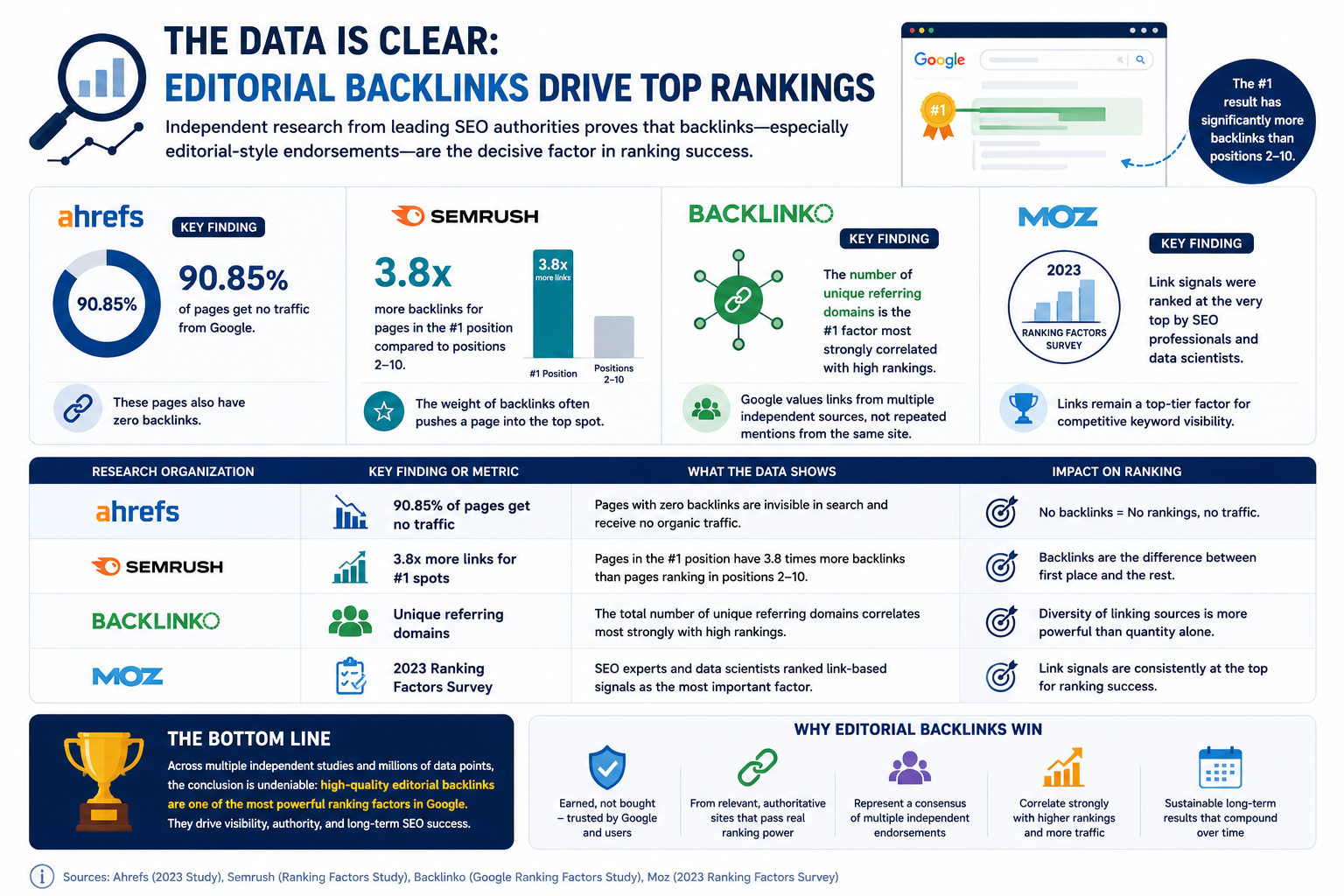
90.85% of all pages receive zero organic traffic from Google. According to a massive study by Ahrefs, this lack of visibility is frequently tied to a total absence of external links. Without these endorsements, pages often remain invisible to the crawlers that determine relevance and authority. This suggests that even the most helpful content can fail if it exists in a vacuum without the “neighborhood” of other websites to vouch for it. The study highlights that the more competitive a search term becomes, the more essential these external signals become for breaking into the top results.
Industry Research
Research from Semrush further quantifies this advantage by examining the specific positions on the first page of search results. Their data indicates that pages sitting in the coveted top spot typically have 3.8 times more backlinks than those occupying positions two through ten. This gap illustrates that while many factors help a page reach the first page, it is often the weight of editorial-style endorsements that pushes a result into the number-one position. The correlation is so strong that it persists across various industries and keyword types.
| Research Organization | Key Finding or Metric | Impact on Ranking |
|---|---|---|
| Ahrefs | 90.85% of pages get no traffic | Directly linked to zero backlinks |
| Semrush | 3.8x more links for #1 spots | Separates the top result from the rest |
| Backlinko | Unique referring domains | Strongest correlation with high rankings |
| Moz | 2023 Ranking Factors Survey | Link signals consistently ranked at the top |
Backlinko conducted an analysis of millions of search results and found that the number of unique referring domains-different websites linking to a page-was the factor that correlated most strongly with high rankings. This finding emphasizes that Google values a consensus from multiple independent sources rather than repetitive mentions from the same place. In the Moz 2023 ranking factors survey, SEO professionals and data scientists mirrored this sentiment, placing link-based signals at the very top of the hierarchy for competitive keyword visibility.
“The data doesn’t lie; while Google has integrated many new signals over the last decade, the relationship between a healthy link profile and high visibility remains the most consistent trend we see in our research.”
– Industry Research Lead
The Importance Of Quality
These studies generally interpret “quality” as links that appear naturally within the body of a page’s content, rather than those hidden in footers or sidebars. This distinction is vital because it explains why a site can have thousands of low-tier links and still be outperformed by a competitor with a handful of high-authority mentions. The empirical evidence makes it clear that while the algorithm is looking for trust, that trust is measured through the lens of external validation. However, the exact way these links translate into a ranking boost-whether they pass “juice” directly or simply improve the site’s overall reputation-remains a point of significant nuance.
How Editorial Links Affect SEO
Deciding whether to prioritize internal content optimization or external outreach often presents a false choice for the modern site owner. While technical health ensures a site is readable, the specific influence of editorial links functions more like a high-voltage power grid for a digital property. They do not merely “boost” a page; they fundamentally alter how the search engine perceives the domain’s authority and reliability across its entire architecture.
One of the most immediate benefits of these placements is the optimization of crawl budget and indexing speed. When a highly active news site or industry journal links to a new article, Google’s spiders discover that content significantly faster than they would through a standard sitemap. For a growing site, this means the difference between a page being indexed in hours rather than weeks. Effectively shortening the time between publication and potential revenue generation.
“The impact of an editorial link is rarely confined to a single URL; it acts as a vote of confidence that elevates the perceived value of every neighboring page on that domain.”
– Senior SEO Strategist at a leading global agency
Editorial links directly improve Domain Authority (DA) and Domain Rating (DR) scores. While these are third-party metrics from tools like Moz or Ahrefs, they serve as reliable proxies for the competitive strength a site carries in search results. A higher domain-level trust allows smaller, less-optimized pages to rank more easily. This is because they inherit the “reputation” of the broader site. This systemic lift is far more valuable than a temporary spike in traffic from a single keyword.
The Mechanics of Trust and Relevance
The algorithm uses these links to decipher topical relevance. If a technology blog receives a link from a major cybersecurity publication, the context of that link tells the crawler exactly what the target site is an expert in. This is why irrelevant placements-such as a link from a recipe blog to a legal firm-typically have little to no effect. The engine recognizes the lack of a logical connection and may simply ignore the signal entirely.
It is a common myth that exact-match anchor text is the “gold standard” for link building. In reality, over-optimizing the clickable text with specific keywords can trigger spam filters or manual penalties. Natural editorial mentions usually feature branded names or descriptive phrases that vary across different sources. This diversity is what creates a sustainable profile that survives algorithm shifts while building brand visibility and direct referral traffic.
- Enhanced Visibility: Quality placements lead to more brand searches as users recognize the name from authoritative sources.
- Indexing Efficiency: High-authority links prompt more frequent visits from search engine crawlers.
- Authority Growth: Consistent earned links increase the overall power of the domain, making it easier to rank for new terms.
- Risk Mitigation: Natural link patterns protect a site from being flagged for manipulative tactics.
The challenge remains that while the benefits of these endorsements are clear, the process of securing them requires a sophisticated blend of high-level content creation and strategic networking. Most digital teams find that simply “writing good content” is no longer enough to catch the eye of major editors. This leads to the complex question of how one actually breaks into these high-tier publications without resorting to the very shortcuts that Google’s systems are designed to catch.
Earning Quality Editorial Backlinks
Audit existing website assets to identify pages that provide unique value, then identify specific journalists who cover those narrow niches. Success in 2026 relies on content quality acting as the primary magnet for attention. A study or a unique data set often serves as the “hook” that makes an editor feel a story is incomplete without referencing the source. High-quality writing is the baseline, but the utility of the information determines if a writer will provide a citation.
Establishing expert contributions allows individuals to trade their specialized knowledge for high-tier mentions. Participating in Help a Reporter Out (HARO) or appearing on industry-specific podcasts creates a bridge between a brand and established media outlets. These platforms prioritize people who can provide quick, accurate, and insightful quotes on trending topics. It is a manual process, but the resulting links carry a weight that automated methods cannot replicate.
Journalists And Publications
Building genuine relationships with journalists and editors remains more effective than sending thousands of cold emails. Effective outreach focuses on relevance over quantity, targeting a handful of high-impact sites rather than a broad list of mediocre ones. A single mention from a site that shares a specific audience is worth more than ten links from unrelated blogs. This targeted approach ensures that the link profile remains natural and resistant to future algorithm updates.
“The most durable links are those where the editor’s decision to include the link was based on the value it adds to the reader, not a business transaction.”
– Senior Media Outreach Consultant
Ethical outreach methods are the only way to ensure long-term safety from Google penalties. This means avoiding “pay-to-play” schemes or private networks that provide artificial boosts. Instead, the focus should be on earned media, where the link is a byproduct of being a helpful resource. Transparency and honesty during the pitch process help maintain the integrity of the domain over several years.
Many businesses find they lack the time or the deep media connections required to manage this level of outreach internally. International Outsourcing Group offers a White Hat Editorial Backlink service designed for these specific scenarios. They focus on obtaining genuine, editorially earned placements through established relationships with authoritative websites. This provides a way to scale the acquisition of high-tier mentions without resorting to risky black-hat tactics or low-quality link farms.
87% of marketers report increased traffic. This often happens after moving away from quantity-based link building toward a strategy centered on high-authority, contextually relevant placements. When an organization prioritizes these signals, they align their growth with the way search engines actually evaluate the web. Focusing on these high-standard placements ensures that every new link contributes to a foundation of trust and long-term visibility.
Conclusion
The internet functions much like a high-stakes engineering system where trust acts as the primary lubricant for the gears of Google’s ranking algorithm. Editorial backlinks are not merely decorative additions to a webpage. They serve as critical validation points that confirm a website’s structural integrity and topical relevance. While the algorithm has evolved to ignore low-quality noise, it continues to prioritize these genuine endorsements. This is because they represent the human element of the internet-expert recognition that cannot be manufactured through automated scripts or transactional schemes.
Ahrefs reports that 66.31% of pages have zero backlinks pointing to them, which directly correlates with a lack of organic search traffic. This data suggests that while content quality is the engine of a website, editorial links provide the fuel necessary to reach the first page of search results. These links function as a vote of confidence from one authority to another. This signals to Google that the information provided is reliable enough to be cited by established peers in the industry. The relationship between high-authority placements and improved visibility remains a constant in an ever-shifting SEO environment.
Core Findings Summary
The core findings of this study highlight several essential truths for those navigating modern search optimization:
- Trust is the primary currency. Google uses editorial links as a proxy for trustworthiness, rewarding sites that earn mentions from reputable news outlets and industry journals.
- Quality outweighs sheer volume. A single link from a high-authority domain like The New York Times or Forbes often provides more ranking power than hundreds of low-tier directory submissions.
- Relevance prevents algorithmic friction. Links must originate from sites within the same or a complementary niche to provide the contextual signals the algorithm requires to categorize content accurately.
- Sustainability requires ethics. Modern SEO demands a shift away from manipulative “link schemes” toward white-hat strategies that focus on relationship building and high-value contributions.
What To Do Next
Readers should begin by auditing their current backlink profile using tools like Semrush or Moz to identify the ratio of editorial links versus automated or low-quality placements. Once the baseline is established, the next step involves identifying five high-authority publications within their specific sector and researching the editors who cover their specific topics. Establishing a connection through helpful data or expert commentary is the most direct path to securing these high-impact signals. For organizations that lack the internal resources to manage these complex media relationships, IOG provides a White Hat Editorial Backlink service that focuses on ethical outreach and genuine placement on authoritative domains.
The algorithm rewards the persistent pursuit of authority over the quick gains of artificial manipulation.
At (IOG) we specialise in securing DA60+ DoFollow editorial backlinks through 100% manual outreach on HARO and Qwoted. With 6 years of experience and over 10,000 placements delivered to SEO agencies and business owners worldwide, we know exactly what it takes to earn links that Google rewards. Visit our Link Order page here and get started today.
Author Bio
IOG’s expert team combines over 100 years of collective experience in business consulting, accounting, bookkeeping, digital marketing, SEO, and content creation. Our qualified professionals work with businesses across the globe to deliver practical insights and strategies that drive real results. We’re committed to creating content that helps business owners make informed decisions and grow their operations.