
Updated August 2026 – 8 Minute Reading Time.
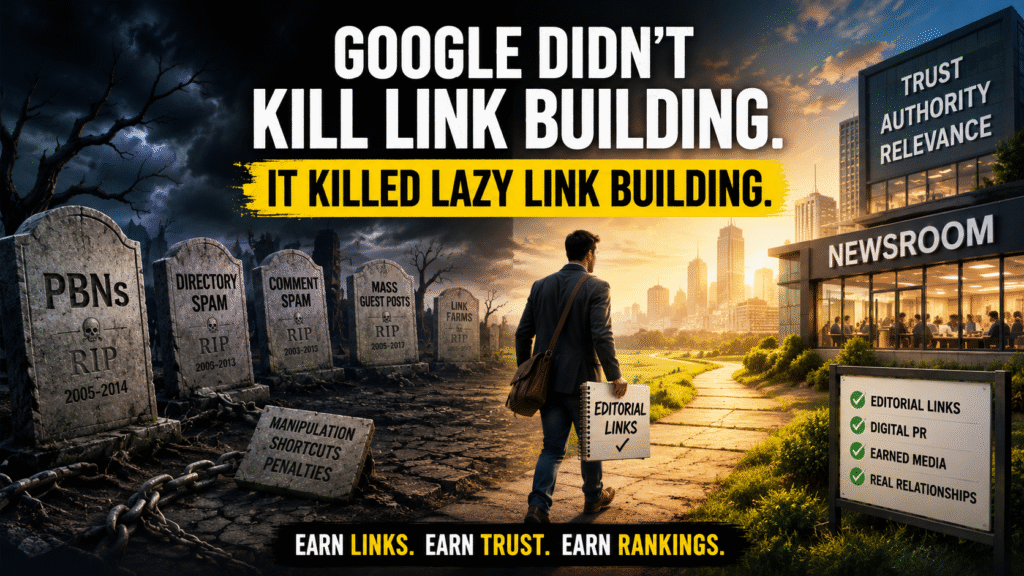
In 2013, a business could buy 10,000 backlinks on Fiverr and watch rankings explode.
Today, the same campaign is more likely to disappear into Google’s spam filters than reach page one.
That’s not because Google stopped caring about links.
It’s because Google finally learned the difference between a recommendation and an advertisement.
Why Businesses Still Believe Link Building Is Dead
Google processed over 25 billion spam pages every single day during its most recent major algorithm updates. This massive digital cleanup led many marketing circles to declare that the era of building links was finally over.
The reality is far more nuanced for those who treat search engine optimization like a high-stakes card game. Google did not remove the value of a recommendation from another website. It simply stopped rewarding the players who try to bluff the system with cheap, low-effort tactics.
The search engine acts as a sophisticated dealer that can now spot “lazy” links from a mile away. In the past, people could climb to the top of search results by buying thousands of low-quality links that served no purpose other than to trick a computer.
What About Google Today?
Today, updates like SpamBrain use artificial intelligence to ignore those shortcuts. This shift makes genuine trust and authority the only currency that still carries weight at the table.
Key Insight: Modern search engines no longer count every link as a vote; they only value “editorial” links, which are mentions earned because a writer or publisher genuinely finds a business noteworthy.
This evolution changes the entire strategy for anyone trying to show up on the first page of results. It is no longer a game of who has the most links, but who has the most respected reputation.
The following chapters explain how the rules changed, why AI makes human trust more valuable, and how to earn the kind of digital recommendations that Google actually rewards.
The Mechanics of Mass Manipulation
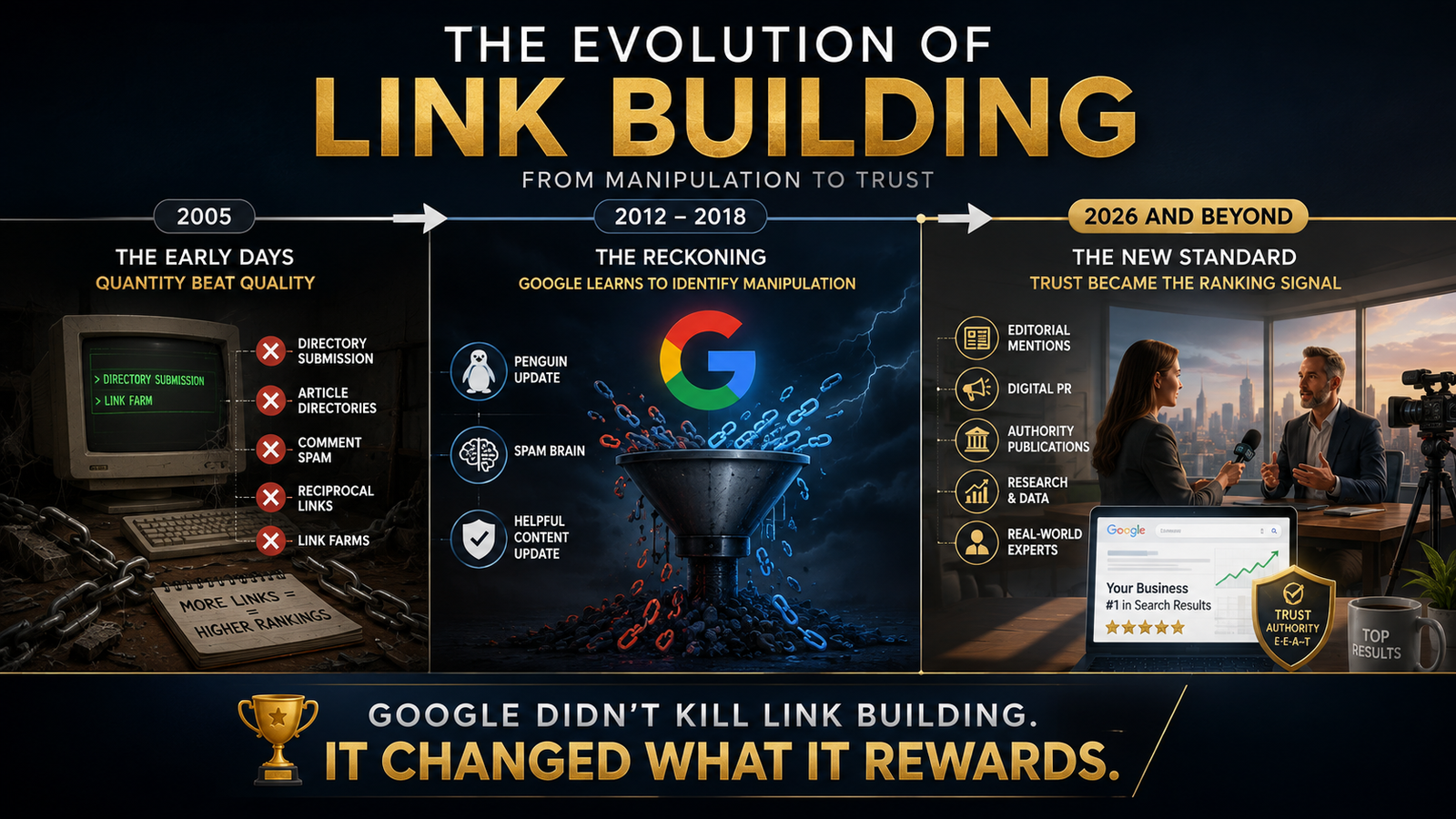
Marketers realized they could inflate a website’s authority by flooding the web with thousands of low-effort mentions. Because the system prioritized link volume over editorial oversight, “lazy” tactics became the industry standard for anyone seeking a quick climb to the top of the results page.
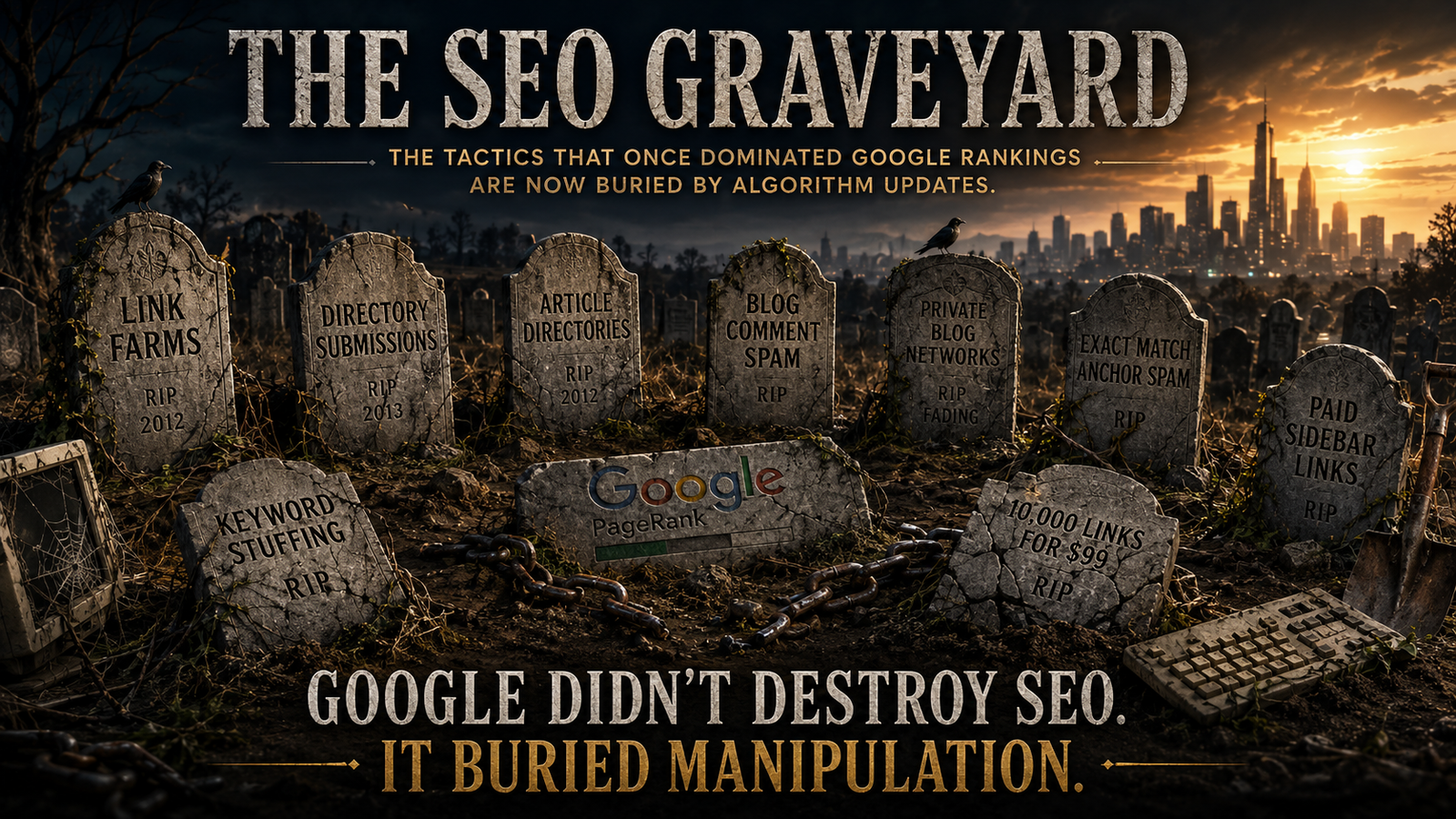
- Article Directories: Submitting thin, 400-word stories to massive repositories like EzineArticles just to secure a backlink.
- Private Blog Networks (PBNs): Building a secret portfolio of expired domains to “pass” authority back to a main site.
- Reciprocal Links: Engaging in “I’ll scratch your back if you scratch mine” schemes that created artificial webs of connection.
- Comment Spam: Using automated bots to drop links into the comment sections of unrelated blogs and forums.
- Mass Guest Posting: Distributing identical, low-quality articles across hundreds of obscure sites.
- Exact-Match Anchor Text: Over-optimizing the clickable text of a link with a specific keyword to force a ranking for that term.
Why the Shortcuts Worked
These methods were alluring because they were cheap, fast, and required zero relationship-building.
Before Google introduced major algorithm updates like Penguin to police these patterns, a site could dominate a niche simply by out-spending competitors on automated link packages.
The system lacked the sophistication to distinguish between a genuine recommendation and a paid placement. This created a digital environment where “gaming the system” was more profitable than creating something of actual value for the user.
It was an era of quantity over quality, where the loudest voice-not the most trusted one-usually won the pot.
How Google Learned to Spot Fake Trust
Google transformed from a simple vote-counter into a sophisticated judge of character by launching a series of algorithmic “police forces” designed to catch digital fraud. The transition shifted the focus from how many people were talking about a site to who was doing the talking and why they were doing it.
The Architecture of Modern Enforcement
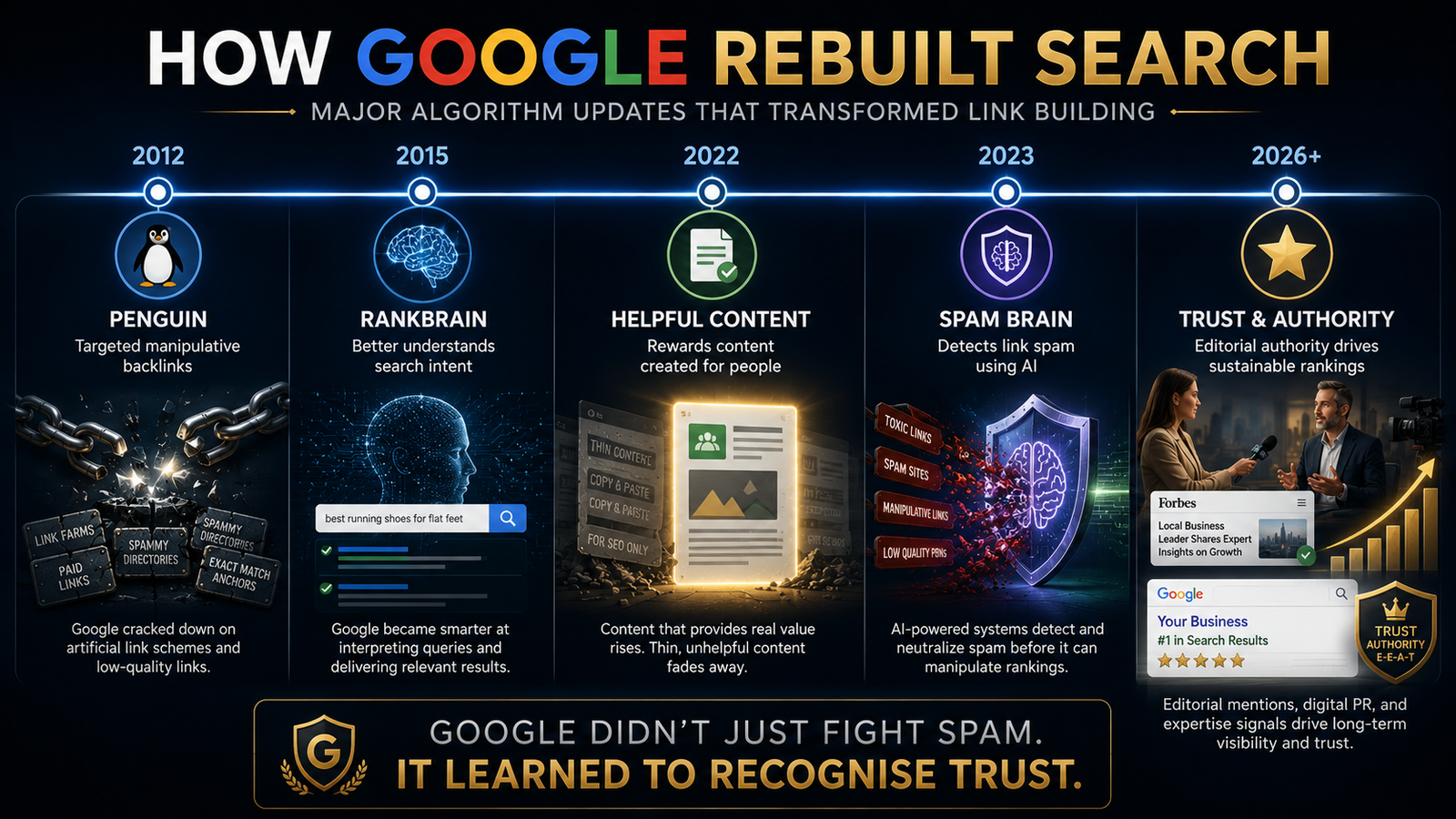
The Penguin update in 2012 served as the first major crackdown, specifically targeting sites that relied on “unnatural” link patterns.
It was the equivalent of a casino boss spotting a card counter; suddenly, thousands of websites that had bought their way to the top saw their rankings vanish overnight.
By 2022, the system evolved further with SpamBrain, an AI-driven platform that identifies spam in real-time. Unlike older versions that required manual refreshes, this AI learns to recognize the subtle footprints of “fake trust” before a site can even benefit from them.
Pro Tip: Evaluate a potential link by asking if it would still be valuable if Google didn’t exist; if the answer is no, the link likely lacks the “editorial judgment” Google now requires.
Evaluating Quality Over Quantity
The Helpful Content Update (2022) added another layer by prioritizing human-centric material over search-engine-first fluff.
Google now analyzes the context and relevance of every mention, ensuring a link from a medical journal carries more weight for a health site than a random comment on a gaming forum.
This evolution is summarized by several key criteria Google now uses to weigh authority:
- Editorial Judgment: Was the link placed by a human editor who genuinely recommends the source?
- Topical Authority: Does the linking site have a proven track record in that specific subject matter?
- Trustworthiness: Is the source a recognized entity with a high E-E-A-T (Experience, Expertise, Authoritativeness, and Trustworthiness) score?
- Natural Placement: Does the link appear within a helpful sentence, or is it shoved into a footer?
The system has moved toward a qualitative model where a single mention from a high-authority publication can outperform a thousand low-tier directory listings. This new landscape ensures that only businesses acting like genuine industry leaders can maintain long-term visibility.
Earning a backlink today is less like placing an advertisement and more like receiving a professional recommendation.
In a landscape where the old shortcuts have been paved over, success belongs to those who treat their website like a respected publication rather than a marketing brochure.
The goal is no longer to “build” a link through sheer force, but to become a business that journalists and industry experts naturally want to reference.
The Power of Digital PR and Expert Commentary
Modern strategies rely on Digital PR campaigns to secure high-quality mentions in major news outlets and industry journals. Instead of cold-emailing for a favor, a business provides expert commentary or unique insights that help a journalist tell a better story.
When a reputable editor cites a brand as a source, they are lending their hard-earned credibility to that business, which is exactly the signal search engines look for.
This process is heavily influenced by E-E-A-T (Experience, Expertise, Authoritativeness, and Trustworthiness). By showcasing deep topical knowledge, a brand becomes a magnet for natural backlinks.
These aren’t just technical connections; they are editorial votes of confidence that strengthen a site’s overall authority in its specific niche.
Creating Assets That Deserve Citations
To attract these mentions, a business must invest in linkable assets. These are high-quality resources that provide genuine utility to the reader, making it easier for others to link to them than to recreate the information.
I have found that original research and data studies are the most effective tools for this, as they provide unique facts that others must cite when reporting on the topic.
- Original Data: Conduct surveys or analyze industry trends to create new statistics.
- Comprehensive Guides: Write the definitive “how-to” that competitors can’t help but reference.
- Interactive Tools: Develop calculators or templates that solve a specific user problem.
- Thought Leadership: Publish contrarian takes or deep-dive analyses that spark industry conversation.
As AI-generated content begins to saturate every corner of the web, these human-verified, editorial mentions act as a vital filter for quality. This shift toward brand authority ensures that the most helpful and trustworthy voices rise to the top of the search results.
The internet is currently witnessing a content explosion that threatens to drown out every unique voice.
With generative tools now capable of churning out endless streams of text, the internet is being flooded with high-volume, low-insight material. In this environment, the mere ability to publish no longer carries weight.
Instead, the scarcity of genuine human validation has turned trust into the most valuable currency in search.
The Saturation of the “Average”
When everyone can produce a 2,000-word article in thirty seconds, the value of that content drops toward zero.
Search engines are faced with a sea of synthetic noise-content that looks correct on the surface but lacks the “human touch” or the “boots-on-the-ground” experience that attracts natural citations.
This saturation makes it impossible for algorithms to rely solely on what a website says about itself.
Google requires a mechanism to distinguish a legitimate industry leader from a sophisticated bot. This is where the weight of a third-party endorsement becomes a critical differentiator.
An independent recommendation acts as a “proof of life” for a brand, signaling that a real person with a real reputation has vetted the information.
Key Takeaway: In an AI-saturated market, a single mention from a respected industry publication is worth more than a thousand pages of unverified, self-published content.
Why Editorial Links Are the Ultimate Filter
Editorial links function as the web’s peer-review system. Unlike automated content, these mentions require a human gatekeeper to exercise editorial judgment before passing along their audience’s trust. This process creates a barrier to entry that “lazy” tactics simply cannot bypass.
For search engines, these earned citations are the most reliable signals of authority.
They prove that a business isn’t just participating in the volume game, but is actually contributing something of value to the broader conversation.
As AI continues to commoditize information, the focus shifts entirely toward who is willing to vouch for that information. This fundamental shift is forcing a complete re-evaluation of what it actually means to build a presence online.
Modern Link Building Is Earning Recommendations
The era of treating search engine optimization like a vending machine-where a specific dollar amount or effort always results in a link-has ended. Success in the current environment requires a fundamental shift in how one views their digital footprint.
A backlink today is less like placing an advertisement and more like receiving a professional recommendation from a peer who has skin in the game.
Modern link building focuses on becoming a business that journalists, publishers, bloggers, researchers, and industry experts naturally want to reference.
When a high-authority site links to a page, they are essentially staking their own reputation on the quality of that source. They aren’t just filling a gap in their text. They are pointing their audience toward a trusted resource.
The Psychology of the Recommendation
There is a massive psychological difference between earning and asking for links. Traditional tactics often relied on high-volume “outreach” that felt like cold-calling a stranger during dinner.
In contrast, reputation building ensures that when a creator looks for a source to back up a claim, a specific brand is the first one that comes to mind.
Businesses that are recommendation-worthy typically share three traits:
- They produce original research or data that doesn’t exist anywhere else on the web.
- They provide expert commentary that adds a unique perspective to breaking news or industry trends.
- They create high-quality resources, such as tools or deep-dive guides, that solve a specific problem better than the competition.
This approach moves the needle from “acquiring” a digital asset to cultivating a lasting authority. It is a transition from a one-off campaign mindset to a continuous effort of being a source of valuable information.
This philosophical foundation is what makes the upcoming practical takeaways so effective in a post-spam world.
Instead of trying to trick an algorithm into seeing value, the objective is to create value that is impossible for the algorithm to ignore.
When a business becomes a primary source for its niche, the links follow as a natural byproduct of its standing in the professional community.
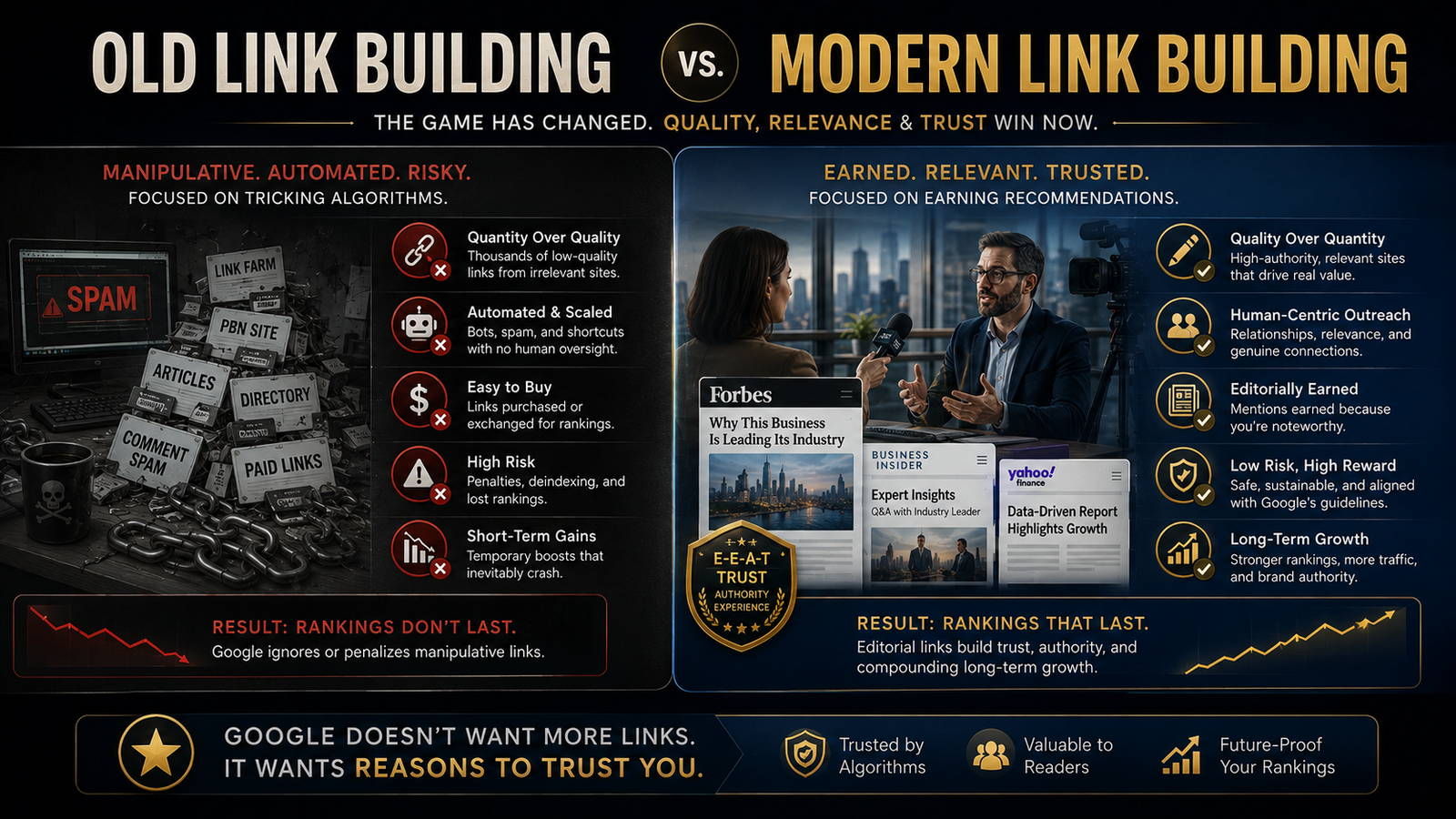
Trust Is the Only Currency That Still Matters
Google has raised the stakes by turning search rankings into a game of high-level credibility rather than a race for volume. The algorithm no longer rewards the player with the most chips; it rewards the player who can prove they belong at the table through genuine editorial endorsements.
A backlink today functions as a professional recommendation.
When a reputable publisher links to a site, they are putting their own reputation on the line.
This shift means that “lazy” tactics-like buying bulk comments or using private blog networks-are now losing bets that Google’s SpamBrain and Helpful Content updates easily identify and fold.
Key Takeaways for Future-Proof SEO
- Quality overhauls quantity: One link from a top-tier industry publication carries more weight than 1,000 links from low-quality directories.
- Trust is the ultimate filter: As AI-generated content floods the web, Google uses editorial links as human-verified signals of E-E-A-T (Experience, Expertise, Authoritativeness, and Trustworthiness).
- Context creates value: Links must appear within relevant content that provides actual utility to the reader to be counted as a vote of confidence.
- Relationships drive rankings: Modern success depends on digital PR and building connections with journalists who seek expert commentary and original research.
Next Steps for Your Strategy
The reader should audit their current backlink profile to identify and disavow low-quality, manipulative links that might trigger spam filters.
They can then begin a digital PR campaign by identifying three major industry publications and researching the specific topics their editors cover most frequently.
For businesses seeking a sustainable path, International Outsourcing Group offers a White Hat Editorial Backlink service. This approach focuses on relationship-driven outreach and securing mentions in authoritative publications to build lasting brand power.
The businesses that dominate Google’s next decade won’t be the ones with the most backlinks. They’ll be the ones people trust enough to recommend.
Need Help Earning Editorial Links?
At (IOG) we specialise in securing DA60+ DoFollow editorial backlinks through 100% manual outreach on HARO and Qwoted. With 6 years of experience and over 10,000 placements delivered to SEO agencies and business owners worldwide, we know exactly what it takes to earn links that Google rewards. Visit our Link Order page here and get started today.
Author Bio
IOG has been securing powerful Editorial Backlinks for businesses and Agencies for over 6 years with 10,000+ placements secured. Our qualified professionals work with businesses across the globe to deliver practical insights and strategies that drive real results. We’re committed to creating content that helps business owners make informed decisions and grow their operations.