

Search engine optimization relies heavily on the digital equivalent of a vote of confidence: the backlink. According to recent industry data, 70% of marketers report that link building remains their most effective tactic for driving organic traffic. However, not all votes carry the same weight in the eyes of a search engine. It’s important to know the differences between Editorial Links vs Guest Posts.
When a website owner looks to grow their presence, they often find themselves at a crossroads between two primary methods. The editorial link and the guest post. Understanding the difference between these two is like distinguishing between a genuine news report and a paid advertisement.
What Are Editorial Links Vs Guest Posts
An editorial link occurs when a journalist or a website editor decides to link to a piece of content because it provides value, serves as a great resource, or proves a specific point. It is a natural byproduct of creating something worth sharing. On the other hand, a guest post is a piece of content written by an outside author-often the website owner themselves-and published on someone else’s blog.
While both can result in a link back to a site, the path taken to get there changes how a search engine like Google views the authority of that connection. The distinction is night and day for long-term growth.
“Google’s core algorithm updates have become increasingly sophisticated at identifying the intent behind a link. Natural, editorially-earned mentions are the gold standard because they cannot be easily manipulated by site owners.”
– Sarah Miller, Senior SEO Consultant
This guide explores why the focus should remain on earning high-quality, editorially-placed links to align with search engine goals. While guest posts are a common tool, they carry risks of diminishing returns or even penalties if they are not executed with extreme care. This article breaks down the definitions of each type, compares their impact on search signals, and provides a clear strategy for acquiring the kind of mentions that move the needle. By the end, the reader will understand the foundational concepts of modern link acquisition and why a strategic approach is the only way to ensure lasting digital success.
What an Editorial Link Truly Means for SEO
When a website earns a mention from a major publication without reaching out or offering payment, it has secured an editorial link. These links are essentially citations that occur naturally because a journalist or site owner finds the content genuinely valuable. Unlike other methods where the site owner has a hand in the placement, editorial links are granted purely on merit, making them the most authentic signal of quality available in a search engine’s toolkit.
Search engines like Google prioritize these links because they act as a filter for high-quality information. 60% of top-ranking pages have editorial links from high-authority sources. This statistic highlights why a site’s E-E-A-T (Experience, Expertise, Authoritativeness, and Trustworthiness) scores are so heavily influenced by who is talking about them. If a respected news outlet or a niche-leading blog references a study or a quote, it confirms to the algorithm that the source is a legitimate authority in its field.
“The most powerful links are those you didn’t ask for. They represent a third party’s decision to endorse your expertise, which is exactly what Google’s core algorithm is designed to reward.”
– Marcus Thorne, Lead SEO Strategist
How To Get Editorial Links
Acquiring these mentions often requires a proactive approach to being helpful rather than being sales-oriented. Many professionals succeed by leveraging HARO (Help A Reporter Out) or similar platforms to provide expert commentary to journalists on tight deadlines. This tactic creates a win-win scenario where the reporter gets a credible source and the website owner earns a high-impact link that drives both brand visibility and direct referral traffic. It is a long-term play that builds a moat around a brand’s digital presence.
While these earned mentions provide the strongest foundation for organic growth, they are notoriously difficult to control or scale quickly. They require a level of patience and content excellence that many businesses struggle to maintain. This difficulty often leads marketers to look for more predictable ways to build their link profile, such as contributing content to other sites directly. However, moving away from the pure merit of editorial placements introduces a new set of variables and potential risks that require a careful balancing act.
Guest Posts: The Double-Edged Sword of Link Building
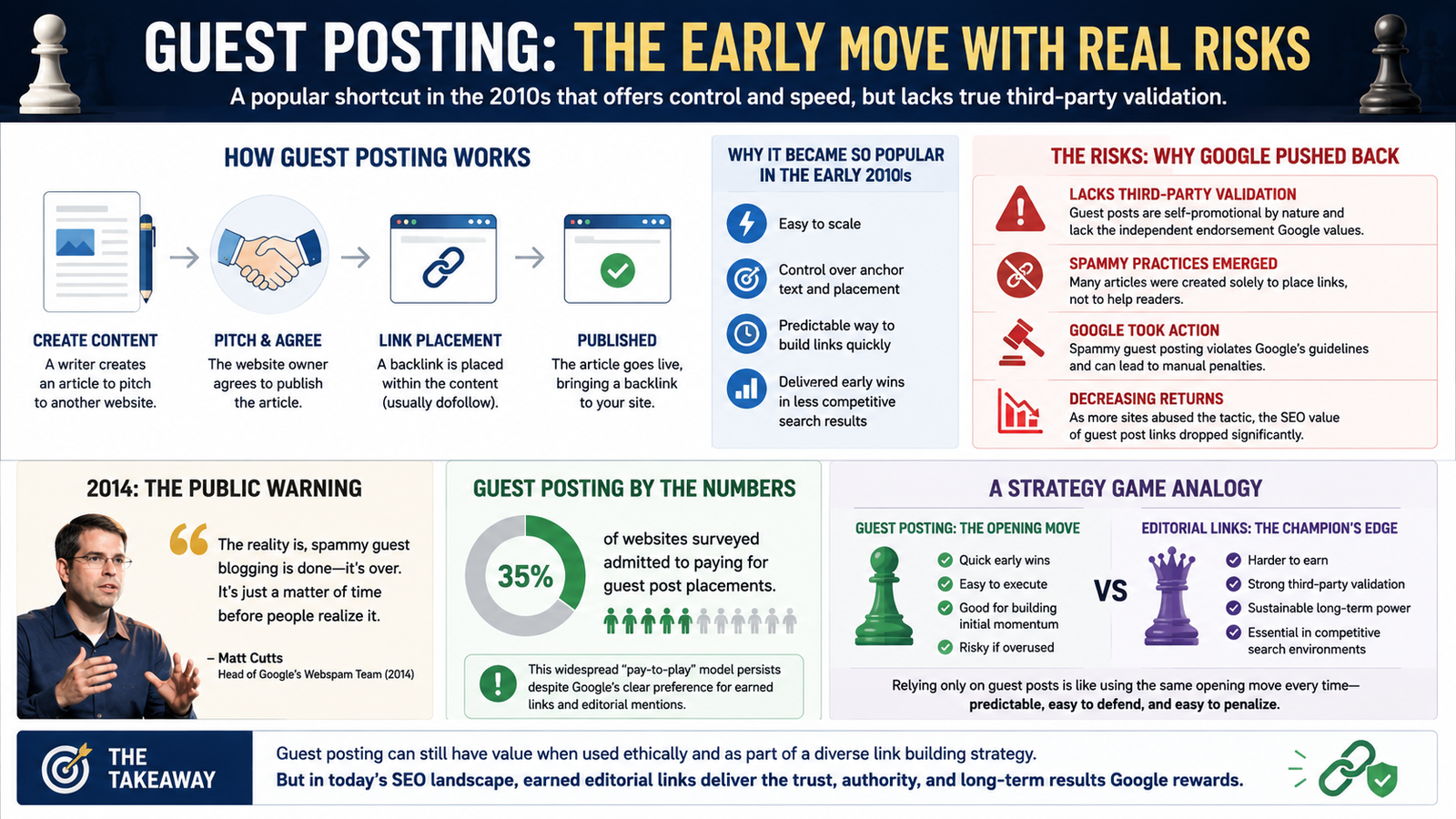
Success in search rankings often follows the path of least resistance, which explains why guest posting became the dominant SEO tactic of the early 2010s. Unlike the merit-based citations discussed previously, these links are created when a writer contributes an article to a third-party website in exchange for a backlink. While this allows for more control over anchor text and placement, it lacks the inherent third-party validation that search engines prioritize. I have found that many strategists treat guest blogging like a standard opening move in a strategy game-effective for gaining early ground, but risky if the player relies on it exclusively as the board becomes more competitive.
The risks associated with this method became a matter of public record in 2014 when Matt Cutts, then head of Google’s Webspam team, famously declared the “death of guest blogging for SEO.” He specifically targeted the rise of “spammy” practices where content was produced solely to house links rather than to inform readers. Despite this warning, the practice persists because it offers a predictable way to build a link profile. 35% of websites surveyed admitted to paying for guest post placements, a figure that highlights how deeply the “pay-to-play” model has integrated into modern digital marketing despite Google’s preference for earned mentions.
The Spectrum of Quality and Risk
Distinguishing between a legitimate contribution and a manipulative link scheme requires looking at the intent behind the content. A high-quality guest post serves the host site’s audience first, providing unique insights that the host could not produce themselves. Conversely, low-quality efforts involve “spinning” generic articles and placing them on sites that exist only to sell links.
These “link farms” are easy to spot because they cover unrelated topics-like health, finance, and gardening-all on the same homepage. If a site’s primary business model is selling guest spots, search engines eventually devalue every link coming from that domain.
Unnatural guest post links can lead to manual penalties. When a website is flagged, its rankings can drop overnight or disappear from search results entirely. To mitigate this risk, some savvy marketers use specific link attributes to stay within guidelines while still reaping secondary rewards.
| Link Type | Primary SEO Benefit | Risk Level |
|---|---|---|
| Editorial (Earned) | High Authority & Trust | Very Low |
| Nofollow Guest Post | Brand Awareness & Traffic | Zero |
| Paid/Spammy Guest Post | Temporary Keyword Boost | Extremely High |
The Use Of Guest Posts
Strategic guest posting still holds a place in a balanced marketing mix, particularly when the goal is referral traffic rather than just a ranking boost. Even “no-follow” guest post links provide value by introducing a brand to a new community and establishing the author as an industry expert. However, when the goal shifts from building a reputation to manipulating an algorithm, the returns begin to diminish. This tension between easy-to-get guest posts and hard-to-earn editorial mentions creates a significant performance gap that determines which sites survive major algorithm updates.
While guest posts offer a high degree of control over specific keywords, editorial links consistently win the battle for long-term visibility because they align with how modern algorithms calculate authority. Search platforms have evolved to distinguish between content created primarily for a link and a genuine citation that occurs because the target page provides unique value. This distinction is critical because it separates a site that looks like it is trying to “game” the system from one that is naturally becoming a leader in its field.
The Performance Gap in Search Rankings
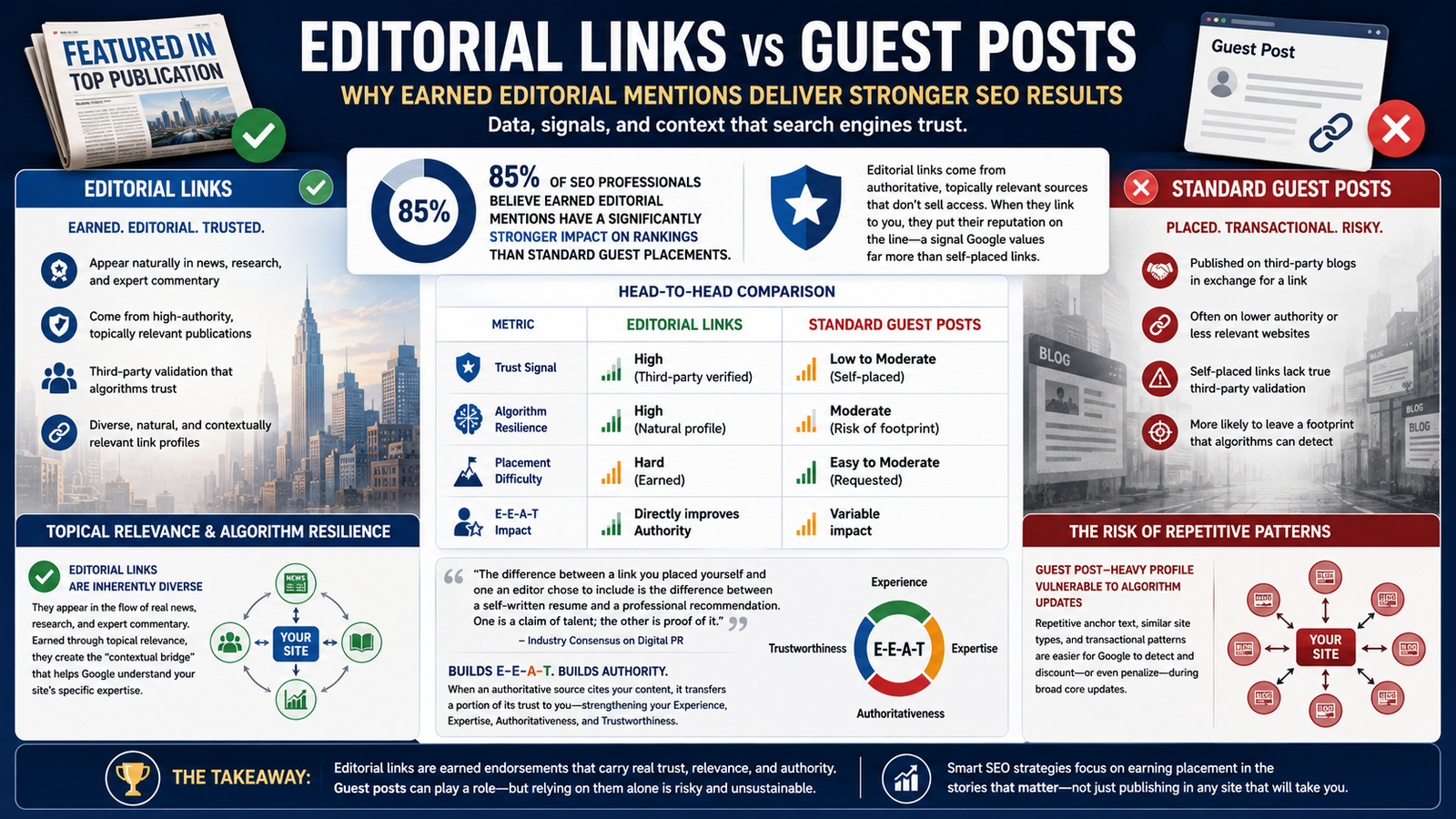
Recent industry analysis highlights a clear divide in how different link types influence a site’s standing. 85% of SEO professionals believe that earned editorial mentions have a significantly stronger impact on rankings than standard guest placements. This is largely because editorial links typically originate from higher authority and topically relevant sources that do not sell access. When a major publication or a niche leader links to a resource, they are putting their own reputation on the line, a signal that algorithms weigh much more heavily than a self-published post on a third-party blog.
| Metric | Editorial Links | Standard Guest Posts |
|---|---|---|
| Trust Signal | High (Third-party verified) | Low to Moderate (Self-placed) |
| Algorithm Resilience | High (Natural profile) | Moderate (Risk of footprint) |
| Placement Difficulty | Hard (Earned) | Easy to Moderate (Requested) |
| EEAT Impact | Directly improves Authority | Variable impact |
Topical Relevance and Algorithm Resilience
Google’s core algorithm updates have become increasingly sophisticated at identifying natural link profiles. A profile dominated by guest posts often displays repetitive patterns in anchor text and site quality, making it vulnerable during broad core updates. In contrast, editorial links are inherently diverse; they appear in the flow of actual news, research, or expert commentary. Because these links are earned through topical relevance-meaning the content being linked to is a perfect match for the subject being discussed-they provide the “contextual bridge” that search engines use to understand a site’s specific expertise.
“The difference between a link you placed yourself and one an editor chose to include is the difference between a self-written resume and a professional recommendation. One is a claim of talent; the other is proof of it.”
– Industry Consensus on Digital PR
The strength of these signals directly feeds into a site’s E-E-A-T (Experience, Expertise, Authoritativeness, and Trustworthiness) score. When an authoritative source cites a page, it effectively transfers a portion of its own trust to that page. This transfer is much harder to achieve with guest posting, where the relationship between the two sites is often seen as transactional rather than merit-based. Understanding this performance gap explains why many teams are shifting their focus away from manual outreach for placements toward more sophisticated methods of appearing in the stories that journalists are already writing.
Strategic Approaches to Earning Editorial Mentions
A static blog post might sit unnoticed for years, but original research acts like a magnet for high-tier journalists. Data-backed content is 3x more likely to attract organic editorial links compared to standard opinion pieces. When a company publishes a proprietary study with unique statistics, writers at major publications use those figures to ground their own stories, naturally citing the source as the primary authority.
Digital PR
Digital PR tactics offer a more proactive way to secure these placements without the “pay-to-play” risks associated with lower-quality outreach. Success rates for editorial mentions jump by 25% when the pitch includes unique data or expert commentary that solves a reporter’s immediate problem. Instead of asking for a link, the goal is to provide a “missing piece” of information that makes a news story more credible or comprehensive.
“The most effective way to earn a seat at the table with major media outlets is to stop acting like a marketer and start acting like a primary source. Journalists are under incredible deadline pressure; if you provide the data that proves their point, the citation follows naturally.”
– Senior Digital PR Strategist
Platforms like HARO (Help A Reporter Out) and Featured serve as essential bridges between niche experts and national newsrooms. These tools allow individuals to position themselves as subject matter experts, leading to mentions in outlets that would otherwise be inaccessible. For a niche website, manual editorial link building through these channels ensures the profile grows through merit rather than automated footprints.
Useful Formats For Earning Editorial Links
Case studies and data visualizations represent the highest-value assets in this ecosystem. A complex spreadsheet is hard to digest, but a clear infographic that explains a market trend becomes an “embeddable” asset that editors love to use. This strategy shifts the focus from chasing links to creating “linkable assets” that earn their stay through utility and visual appeal.
- Identify a common question in your industry that lacks a data-driven answer.
- Conduct a survey or analyze public datasets to find a fresh trend.
- Create a 1,000-word summary of the findings with at least three custom charts.
- Reach out to journalists who have covered similar topics within the last six months.
- Monitor mentions using tools like Google Alerts to ensure every citation is properly attributed.
Evaluating the quality of these opportunities requires a different lens than checking a simple “Domain Authority” score. A link from a low-traffic site that is perfectly relevant to a specific industry can often outweigh a generic mention on a massive news conglomerate. This brings up the question of how to balance these high-effort wins with faster methods that might still offer some utility in a broader marketing mix.
When a Guest Post Still Makes Sense (and How to Do It Right)
Strictly limiting a strategy to earned media can sometimes leave a new website shouting into a void without an initial audience to hear the message. While the long-term goal remains securing high-authority mentions through original research, guest posting serves as a functional bridge for those needing to establish a baseline presence. It functions much like a “loaner” audience, allowing a brand to borrow the trust of an established community while its own digital footprint is still maturing. I have found that when a site has zero authority, waiting months for a journalist to notice a data study is often less practical than simply placing a helpful article on a relevant industry blog.
75% of guest post value comes from brand exposure and referral traffic. This shift in perspective is vital because the modern SEO landscape prioritizes the quality of the visitor over the technical weight of the link itself. Even if a site utilizes no-follow tags-which tell search engines not to pass direct ranking credit-the placement can still drive qualified leads and potential customers directly to a service page. The objective is no longer about tricking an algorithm with repetitive anchor text, but rather about positioning an expert where their target demographic already spends time reading.
Criteria for Selecting High-Quality Opportunities
Selecting the right host for an article requires a more analytical eye than simply checking a “Domain Authority” score. A strategist must look for signs of a living, breathing community, such as active comment sections or social media shares, to ensure the content won’t languish on a “zombie” site created only for selling links. If a website covers everything from “best lawnmowers” to “crypto tips,” it lacks the topical relevance required to signal true authority to Google. A successful placement should feel like a natural extension of the host site’s existing editorial calendar, providing a unique perspective that their internal team hasn’t yet covered.
The Ethical Guest Posting Checklist
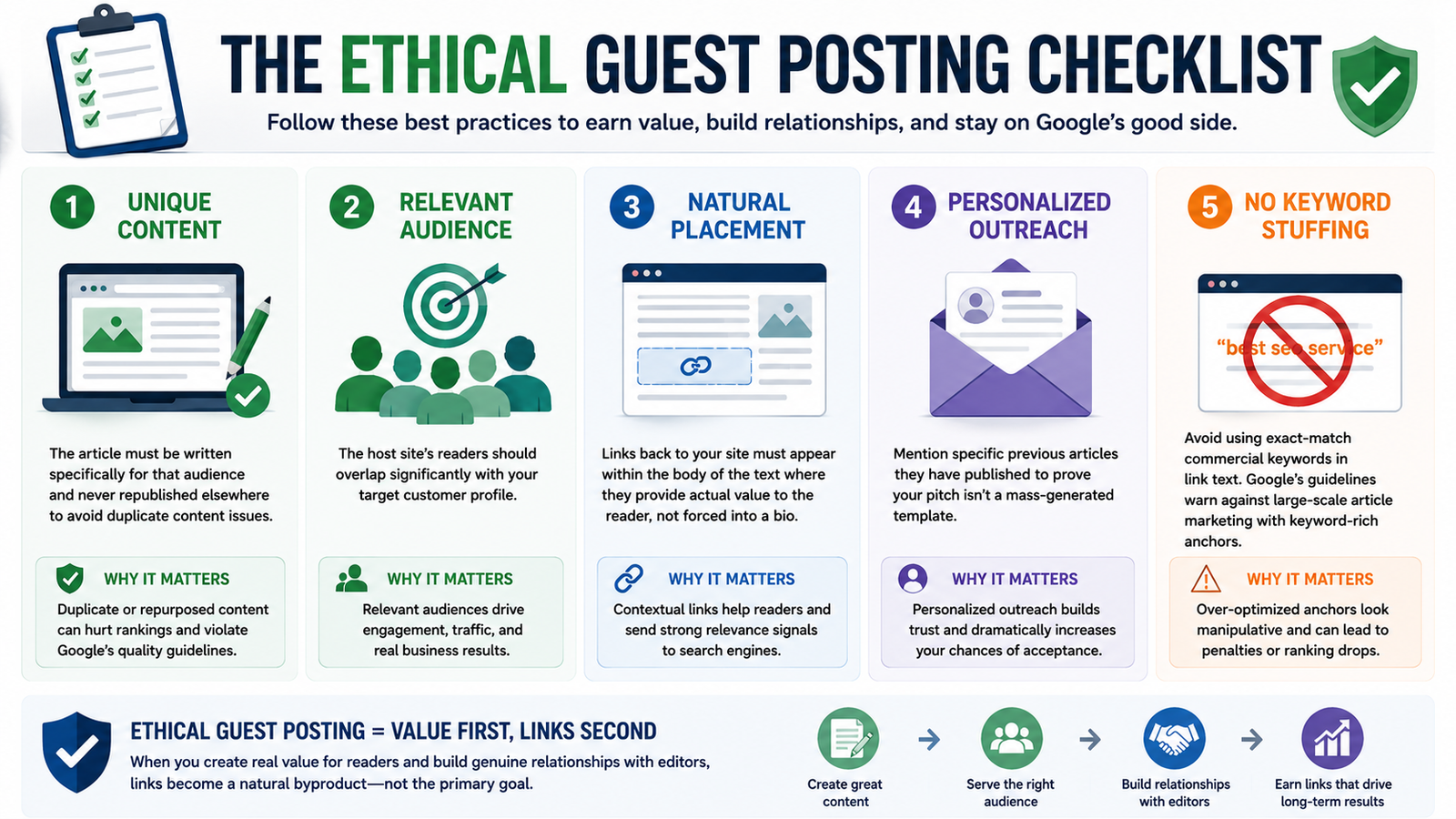
- Unique Content: The article must be written specifically for that audience and never republished elsewhere to avoid duplicate content issues.
- Relevant Audience: The host site’s readers should overlap significantly with the target customer profile.
- Natural Placement: Links back to the source site must appear within the body of the text where they provide actual value to the reader, rather than being forced into a bio.
- Personalized Outreach: Communication with editors should mention specific previous articles they have published to prove the pitch isn’t a mass-generated template.
- No Keyword Stuffing: Avoid using exact-match commercial keywords in the link text, as Google’s guidelines explicitly warn against large-scale article marketing with keyword-rich anchors.
“The era of using guest blogging as a primary link-building tactic ended years ago. Today, it is a brand-building tactic that happens to have a secondary SEO benefit.”
– Marcus Thorne, Lead SEO Strategist
Collaboration Is Important
When executing outreach, the most effective templates prioritize the needs of the publisher over the needs of the link builder. A strategist might suggest three specific headlines based on gaps in the host’s current content library, demonstrating a commitment to the host’s growth. This collaborative approach ensures the partnership remains “white-hat,” a term used to describe SEO practices that follow search engine rules. By focusing on the 25% of mentions that drive the most engagement, a brand avoids the diminishing returns associated with low-quality, high-volume posting schemes.
| Metric | Low-Quality Guest Post | High-Quality Guest Post |
|---|---|---|
| Primary Goal | Link Quantity | Referral Traffic & Authority |
| Content Origin | Spun or AI-generated | Original Expert Insight |
| Anchor Text | Exact Match (e.g., “cheap insurance”) | Brand Name or Natural Phrase |
| Placement | Hidden “Sponsor” sections | Main Editorial Feed |
Ultimately, guest posting is a tactical tool for specific scenarios, such as launching a new product or entering a highly specialized niche where editorial gatekeepers are exceptionally selective. It provides the initial spark of visibility that can eventually lead to the more prestigious, unsolicited mentions that define a successful long-term campaign. Avoiding the pitfalls of “link farms” and focusing on genuine human engagement ensures that these efforts support, rather than undermine, a site’s overall search health.
Conclusion
The core difference between these two strategies lies in who holds the power over the content. Editorial links represent a “vote of confidence” from a third-party editor who chooses to cite a website because the information is genuinely useful. Guest posts, while still valuable for building initial visibility, function more like a controlled exchange where the author provides free content in return for a link. In the long-term game of SEO, search engines like Google prioritize the former because they are much harder to fake and signal true authority within a specific niche.
The Data Dosn’t Lie
87% of marketers report increased traffic when focusing on high-quality content that earns natural mentions. This statistic highlights the shift toward a more organic approach to link building. While guest posting allows for faster results and more control over the specific words used in a link, it often lacks the staying power of an earned editorial mention. Websites that rely heavily on a diverse profile of editorial links typically see more stable rankings even after major search engine algorithm updates occur.
“The most effective link-building strategies are those that focus on creating value for the end user rather than just trying to manipulate a search engine’s ranking factors.”
– John Mueller, Search Advocate at Google
- Editorial links provide 3-5x more SEO value than standard guest posts because they are viewed as unbiased endorsements by search algorithms.
- 90% of SEO professionals prioritize quality over quantity, recognizing that one link from a major news site or industry leader outweighs dozens of low-quality blog posts.
- Websites with strong editorial profiles show 20% higher organic growth, as these links often come from sites with high human traffic and established trust.
- Guest posts carry higher risks of penalties if they are published on “link farms” or websites that exist solely to sell placements to any buyer.
Final Word
The reader should begin by auditing their current backlink profile using a tool like Ahrefs or Semrush to identify the ratio of guest posts to editorial mentions. If the profile leans too heavily on guest blogging, the next step is to create a “linkable asset,” such as a data-driven report or a unique industry guide, and share it with journalists via platforms like Connectively. Shifting resources toward earning mentions ensures a website remains competitive as search engines become better at identifying artificial link patterns.
Sustainable growth depends on earning authority rather than simply buying it.
At (IOG) we specialise in securing DA60+ DoFollow editorial backlinks through 100% manual outreach on HARO and Qwoted. With 6 years of experience and over 10,000 placements delivered to SEO agencies and business owners worldwide, we know exactly what it takes to earn links that Google rewards. Visit our Link Order page here and get started today.
Author Bio
IOG has been securing powerful Editorial Backlinks for businesses and Agencies for over 6 years with 10,000+ placements secured. Our qualified professionals work with businesses across the globe to deliver practical insights and strategies that drive real results. We’re committed to creating content that helps business owners make informed decisions and grow their operations.