

Most partners, owners and senior managers are not short of ambition. They are short of uninterrupted time. The inbox fills, the calendar double-books, travel sits half-organised, and the work only they can do — clients, deals, decisions — keeps sliding to the end of the day.
A virtual executive assistant (VEA) is the remote professional whose job is to take that load off your desk and keep it off. This guide explains what the role actually covers, who gets value from it, how to think about cost, and how to start without turning yourself into a full-time supervisor.
What a virtual executive assistant is (and is not)
A VEA is a remote executive assistant. They work in your calendar, email and documents, from their own location, using the same tools you already use — Microsoft 365, Google Workspace, your practice or CRM system, Zoom or Teams.
They are not a generic “do everything cheaply” contractor, and they are not a replacement for a chief of staff. The useful test is this: if the task is important, recurring, and below the rate you should be charging or thinking at, it belongs with a VEA. If it is a one-off strategic decision, it stays with you.
International Outsourcing Group delivers this through virtual administration services — a managed person, not a résumé in your inbox.
The work that should leave your desk
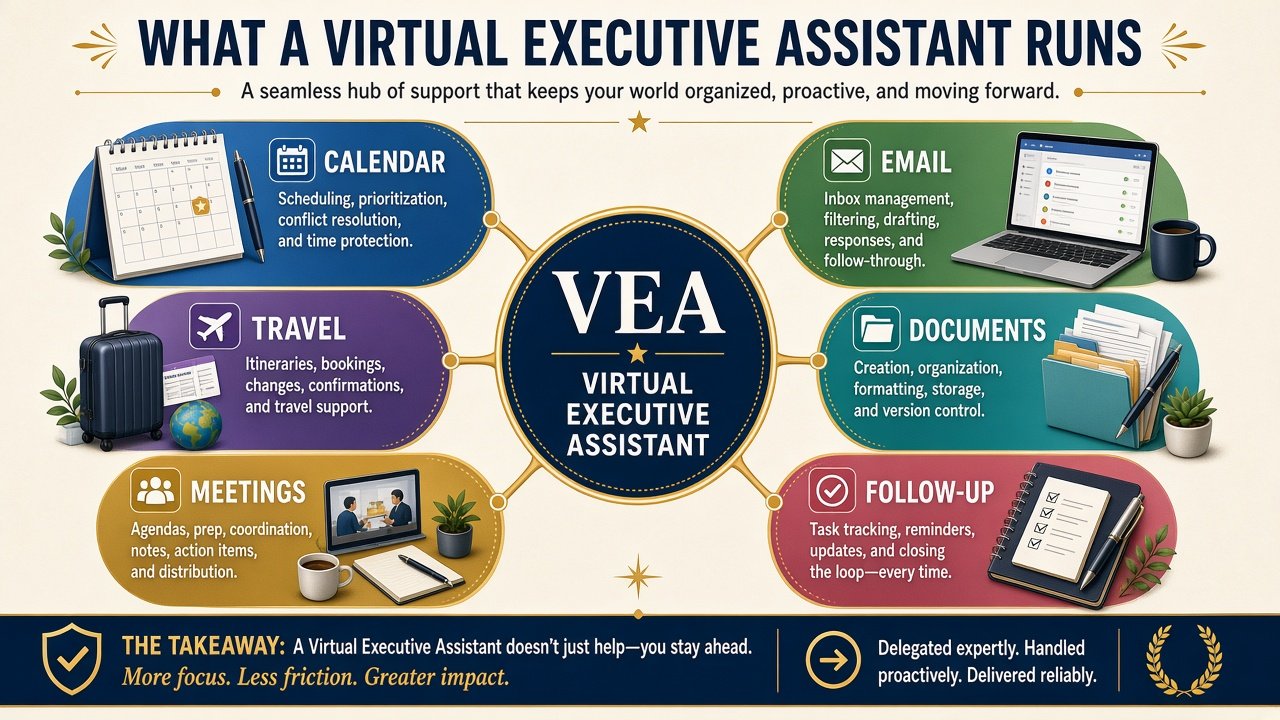
A good brief is a list of outcomes, not a vague “help with admin”. Typical VEA work includes:
- Calendar control — holds, buffers, no overlapping commitments, and a week that matches your priorities rather than whoever shouted first
- Email triage — inbox zero is less important than a sorted inbox: what needs you, what can be drafted, what can wait
- Travel and logistics — flights, accommodation, itineraries, and the documents you need on the day
The same remote model covers more specialised admin. If your world is property, law or people operations, see real estate administrative assistants, hiring a legal admin assistant, and HR administrative assistants.
Who gets the most from a VEA
Anyone time-poor can use one. The people who feel the difference fastest tend to be:
- Partners and senior associates in law, accounting and engineering firms
- Founders and owner-operators who are still the rainmaker and the office manager
- Consultants whose billable time is the product
- Medical and dental principals whose clinical hours are the constraint
- Marketing and agency leads buried in coordination rather than client work
- Real estate principals who should be listing and negotiating, not chasing paperwork
If the practice also needs the books kept current, pair the VEA with virtual bookkeeping rather than asking one person to be both assistant and bookkeeper. For clinical practices, bookkeeping for doctors is a useful companion read.
Signs you are past DIY admin
You do not need a dramatic crisis. These patterns are enough:
- Important email sits for days because it is buried under noise
- You are the bottleneck for every meeting time, every flight, every signed PDF
- You do work a capable assistant would finish in a third of the time
If three or more of those are true, a VEA is usually cheaper than the hours you are already leaking.
Managed support versus a cheap unsupervised VA
A low hourly rate is not a bargain if you spend Monday mornings explaining the same process, correcting the same tone, and checking whether the diary conflict was actually resolved.
Unmanaged, untrained assistants transfer the management load back to you. That is the opposite of the job. A better structure is a provider that recruits, trains, supervises and covers leave — so you brief outcomes, not HR.
That is how IOG runs administration: you get a remote executive assistant plus a management layer. Slightly more than a bare contractor; far less of your own time.
How to think about cost
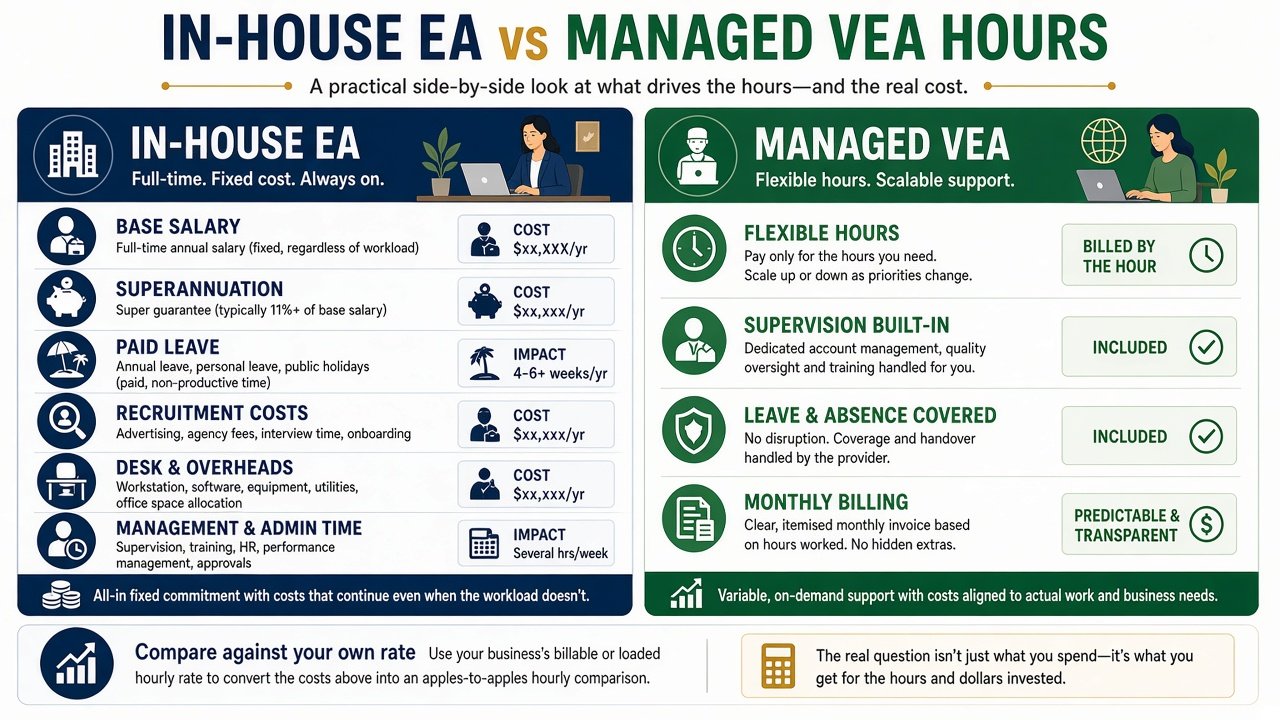
A full-time in-house assistant carries salary, superannuation, leave, recruitment, equipment and a desk. That can be the right call if you need someone physically present every day. For most executives, the constraint is hours of support, not a body in the next room.
Outsourced VEAs are remote, so you are not paying for floor space. You also do not have to buy a full week. Many clients start with a small weekly block — a day a week is common — and change hours month to month as deals, court, or travel load shifts. IOG bills monthly, with no establishment fee and no charge to change hours.
The other half of the equation is the time you get back. That is not a promised revenue multiple. It is a simple test: if five hours a week return to billable or business-development work, does that outweigh the assistant hours you bought? Only you can run that number against your own rate. We will not invent a percentage saving that pretends to apply to every firm.
How to start without a six-month onboarding
Keep the first month boring and specific:
- Write the ten tasks that steal your mornings (be concrete: “triage inbox to a daily shortlist”, not “help with email”).
- Estimate hours. Start slightly low; it is easier to add than to invent work.
- List systems and access: calendar, email, video, document store, any CRM.
- Agree a communication rhythm — a daily note, a weekly call, or both.
- Give decision rules (“never accept a meeting over 45 minutes without asking me”).
IOG can usually have someone working inside that brief within about a week, once access is in place.
How International Outsourcing Group provides a VEA
International Outsourcing Group supports Australian businesses with administration, bookkeeping and marketing. For executives, the relevant product is managed administration services — calendar, email, documents, scheduling and the repetitive work that should not sit with a partner or owner.
Hours flex month to month. Billing is monthly. You are not locked into a headcount you cannot unwind. If the same firm also needs a cleaner pipeline or a stronger website, the marketing side can sit alongside — including outsourced marketing and white-hat editorial backlinks when authority is the growth gap. Sales-heavy teams may also want a dedicated sales admin assistant rather than stretching one VEA across every CRM task.
Next step
If your week is full and your highest-value work is not, contact us with the tasks you want off your desk, a rough weekly hour range, and the tools you use. We will propose a monthly VEA plan you can adjust as the load changes.